
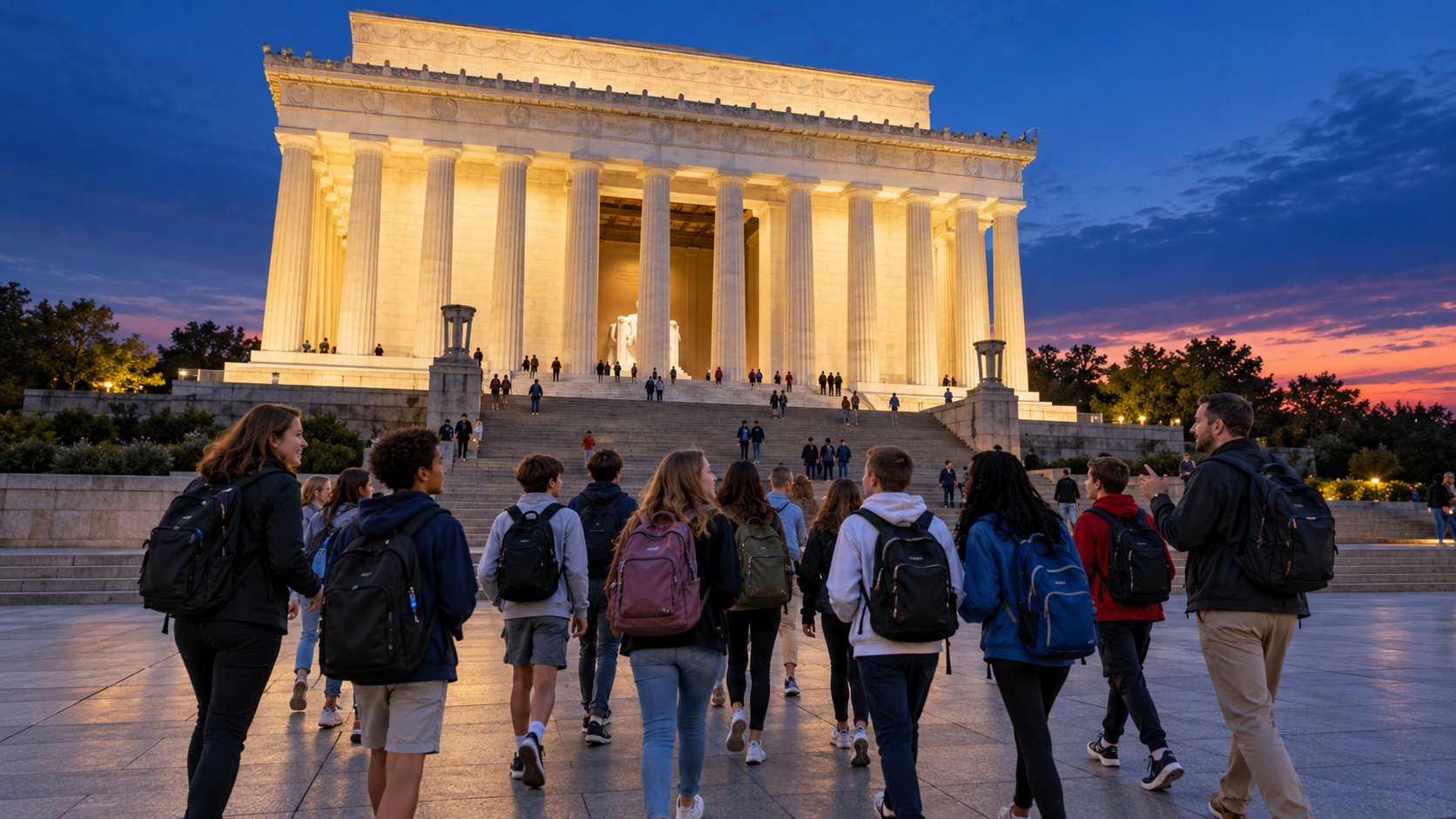
Three days is the sweet spot for middle school trips to Washington D.C.: long enough to cover the essential memorials, museums, and monuments, short enough to keep 13-year-olds engaged and your budget intact. Below is a sample of how Son Tours paces a 3-day trip for 8th graders — no ten-hour museum marathons, built-in downtime, and an evening monument tour students talk about for years.
Every Son Tours itinerary is fully customized to your curriculum, so treat this as a starting point, not a fixed script.
Day 1: Arrival and Monuments by Moonlight
Morning/Afternoon — Arrive and get oriented. Your motorcoach rolls into Washington midday. After hotel check-in and a group lunch, the afternoon starts with something big and visual: the Smithsonian National Museum of American History or the National Museum of Natural History. These are high-energy, hands-on museums that hook middle schoolers fast — the Star-Spangled Banner, the Hope Diamond, the dinosaur hall. One museum, not three. That's a deliberate choice.
Late afternoon — Walk the Tidal Basin. If you're traveling in spring, the cherry blossoms frame the Jefferson Memorial and FDR Memorial beautifully. In other seasons, it's still one of the best walks in the city — open air, room to move, and memorials that read like chapters of the American story.
Evening — Monuments by moonlight. This is the signature experience of a Son Tours D.C. trip. After dinner, your group tours the Lincoln Memorial, Vietnam Veterans Memorial, Korean War Veterans Memorial, and World War II Memorial after dark. The crowds thin, the marble glows, and the solemnity lands in a way daylight crowds rarely allow. For many students, this is the night the trip becomes real.
Night — Hotel check-in and lights-out under the watch of Son Tours' private uniformed evening security — included at no extra cost on every trip.
Day 2: Capitol Hill and the Smithsonian
Morning — U.S. Capitol. The day starts on Capitol Hill with a guided tour of the U.S. Capitol Visitor Center and Capitol Building — the Rotunda, National Statuary Hall, the very rooms where the concepts from civics class actually happened. For 8th graders studying American government, there is no substitute for standing in it.
Midday — Library of Congress and the National Archives. The Library of Congress (Thomas Jefferson's library, the Gutenberg Bible, the ornate Main Reading Room) stuns even screen-saturated teenagers. Then it's across the Mall to the National Archives to stand before the Declaration of Independence, the Constitution, and the Bill of Rights. Two documents-focused stops pair naturally — and they're timed so neither one overstays its welcome.
Afternoon — Smithsonian of your choice. After lunch, the group splits or stays together for a second museum based on your curriculum: Air and Space for the science-minded, African American History and Culture for a profound American story, American History for a second pass at favorites. Your Son Tours coordinator helps you match the museum to what your students are studying.
Evening — Dinner and group reflection. Many teachers use this evening for a structured debrief — journaling, small-group discussion, a "what surprised you today" circle. After two full days of input, students need time to process. Then back to the hotel, with evening security on duty.
Day 3: Arlington and Departure
Morning — Arlington National Cemetery. The final morning is the most moving: the Changing of the Guard at the Tomb of the Unknown Soldier, the rows of white headstones, the JFK gravesite with its eternal flame. It's quiet, it's serious, and it gives the trip a weight that balances the energy of the museums. Many teachers tell us this is the stop students remember longest.
Midday — Final lunch and departure. Depending on your drive time, there's room for one last stop — the National 9/11 Pentagon Memorial is a frequent choice for groups heading south — or a final walk past the White House for the group photo. Then it's onto the motorcoach for home, with a tour director debrief and plenty of tired, happy students.
How This Itinerary Is Paced for 8th Graders
A good student itinerary isn't a list of attractions — it's an energy-management plan. A few principles behind this one:
· One major museum per half-day, max. Museum fatigue is real, and it hits 13-year-olds around hour three. We'd rather they love one museum than endure two.
· Alternate indoor and outdoor. Capitol in the morning, Mall walk in the afternoon. The rhythm keeps energy up.
· Build in downtime. Meals are unhurried. Bus rides between stops are breathing room, not wasted time.
· Front-load the wow, end with meaning. The moonlit monuments create the emotional high early; Arlington gives the trip its gravity at the close.
· Evenings are structured. Free time in an unfamiliar city is where problems start. Every evening has a plan — and private uniformed security at the hotel.
Make It Yours: Fully Customized to Your Curriculum
This is a sample. Your trip won't look exactly like it — and that's the point. Son Tours builds every itinerary around your school: your state standards, the units your students are covering, the sites your teachers care about most. Teaching the Civil Rights Movement this semester? We'll weight the itinerary toward the African American History museum and the MLK Memorial. Deep in a space unit? Air and Space gets the full afternoon.
You'll plan it all with one dedicated coordinator who stays with your school from the first quote to the return home — and every itinerary is vetted for safety by former intelligence and military professionals before your students ever set foot in the city.
If you're weighing 8th grade D.C. trips against other Washington D.C. student tours, ask each operator how much of the itinerary you actually control. With Son Tours, the answer is: all of it. And if you're still deciding how far in advance to book your D.C. student trip, keep in mind that Capitol tour requests have lead-time requirements — another reason to start early.
Request a custom quote and start building your itinerary → Tell us what your 8th graders are studying, and we'll design three days around it.
