
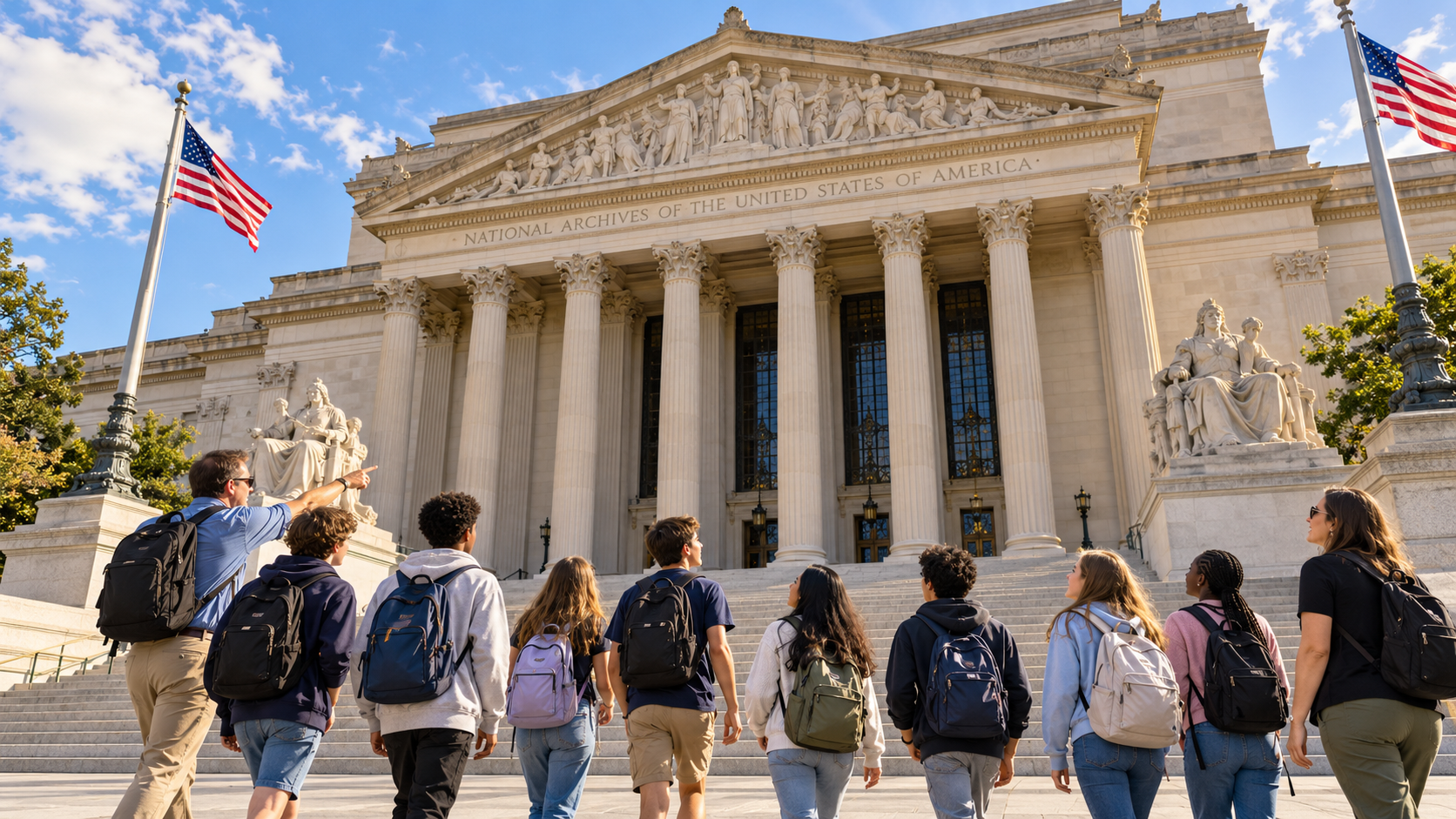
Here's a sentence you can say exactly once in your career: your eighth graders can visit Washington D.C. during America's 250th birthday.
2026 marks the 250th anniversary of American independence, and Washington D.C. is the epicenter of the commemoration — a year of special exhibitions, ceremonies, and programming at the very sites your students study in civics class. If there were ever a year when a middle school trip to Washington D.C. carried extra weight, this is it.
That's the opportunity. Here's what it means practically — and why it changes the math on when you book.
Why 2026 Is a Once-in-a-Generation Year for a Student Trip
Students read about the founding in textbooks. In 2026, they can stand at the National Archives — where the Declaration of Independence, the Constitution, and the Bill of Rights are on display — during the year the nation marks 250 years since the Declaration was signed. Commemorative programming is planned across the National Mall, the Smithsonian museums, and historic sites throughout the city.
This isn't a marketing claim; it's a calendar fact. Semiquincentennial observances are scheduled throughout 2026, with major national moments around Independence Day. For a teacher, the educational framing writes itself: your students aren't just visiting history, they're visiting it at the moment the country is reflecting on it most publicly. That's the kind of context that turns a field trip into a memory students reference in high school essays and college interviews.
What It Means Practically: Bigger Crowds, Tighter Supply
The honest flip side of a landmark year is demand. Here's what to expect and plan for:
Bigger crowds at marquee sites. The National Archives, the Capitol, the marquee Smithsonian museums, and the memorials draw more visitors in milestone years. Timed-entry reservations — already the norm at several sites — become harder to secure, and popular time slots go first.
Hotel and motorcoach demand. D.C.-area hotels and charter motorcoaches are finite resources. In a high-demand year, school groups compete with every other visitor segment for rooms and buses, particularly in the prime spring window (late March through May) when most middle school D.C. field trips travel.
Special programming to plan around. Commemorative events can be a gift — a ceremony at a memorial your group can attend — or a complication, if road closures and security perimeters shift your route. Either way, they require an operator who monitors the city's event calendar and adjusts itineraries in real time.
None of this is a reason not to go. It's a reason to book early and to travel with an operator built for high-traffic conditions.
Why Booking Early Matters — Honest Urgency, Not Hype
We're going to be straight with you: this isn't manufactured scarcity. In a normal year, we advise schools to book well in advance of a spring trip. In 2026, "well in advance" isn't early enough — the schools that lock in hotels, motorcoaches, and timed entries first get the best availability, full stop.
If you're planning a spring 2026 trip and haven't started, start this week. If you're planning for 2027, the 250th programming extends the urgency — commemorative exhibitions often run beyond the anniversary year, and demand patterns ripple outward.
The cost of waiting isn't just availability. It's itinerary quality: the difference between a 10 a.m. timed entry at the Archives and a 4 p.m. one, between a hotel two Metro stops from the Mall and one forty minutes out, between a motorcoach company you've vetted and whoever's left. Early booking buys you the trip you actually want.
How a Veteran-Led Operator Navigates High-Traffic Periods
Big crowds are exactly the conditions Son Tours was built for. Our founders' backgrounds — CIA and 82nd Airborne — mean high-traffic, high-complexity environments are familiar territory, not a stress test. Practically, here's what that looks like for your group:
Insider routing. Our itineraries are sequenced by people who understand crowd flow — which sites to hit at opening, which memorials are better after dark (see our guide to D.C. monuments at night with a student group), and how to order a day so your students spend time experiencing, not queuing.
Timed entries secured early. Because each school gets a dedicated coordinator (not a call center), your reservations are handled by someone who knows your itinerary and is watching the booking windows — not a queue ticket.
Private security, included. In a year with larger crowds and more public events, having private, uniformed security with your group at no extra cost isn't a luxury — it's the difference between navigating a busy Mall confidently and white-knuckling it. Learn exactly what private security does on a student D.C. trip.
Real-time adjustments. Commemorative-year road closures, demonstration permits, and security perimeters change the map. An operator whose planning team thinks like intelligence professionals doesn't just react to disruptions — it anticipates them and has the backup route ready.
The Bottom Line for 2026
Your students get one shot at eighth grade. In 2026, that shot coincides with the country's 250th birthday, in the city where the founding documents live. If you've been on the fence about a D.C. trip, this is the year the fence disappears.
But the window rewards the decisive. Book early, travel with an operator that includes security rather than upselling it, and let the semiquincentennial do what it does best: make the history your students are studying feel like it's happening right now — because in 2026, it is.
Planning a 2026 trip? Request a quote from Son Tours — and let's lock in your dates before the best availability is gone.
