
The Smithsonian is free, it's on the National Mall, and it's enormous — 21 museums and the National Zoo. That's a blessing and a trap. Bring a middle school group to D.C. without a plan, and you'll spend forty-five minutes herding students past a cafeteria while the good stuff sits one floor up.
After 30+ years of leading middle school trips to Washington D.C., we've learned which museums actually land with 13-year-olds, how long to spend in each, and where groups quietly fall apart. Here are our four picks — the ones worth your limited hours.
1. National Air and Space Museum — the classic
This is the museum that turns "I don't care about museums" kids into believers. Actual spacecraft. The Wright Flyer. A lunar module. The thing is the size of a cathedral, and for a generation raised on SpaceX launches, the connection is immediate.
Why it works for 8th graders: It's tactile and spectacular. Students can see the actual Friendship 7 capsule John Glenn flew in, stand under a full-size Apollo-Soyuz test module, and walk through Skylab. If your curriculum covers the Space Race or the Cold War, the exhibits do the teaching for you.
Pacing: 90 minutes is the sweet spot. Pick a theme — early flight, or the Space Race — rather than trying to see it all. The IMAX and planetarium shows cost extra and eat 45 minutes; they're great but only if you've budgeted the time.
Tip: The museum's Udvar-Hazy Center near Dulles Airport is arguably better — it has the Space Shuttle Discovery — but it's a separate bus trip. Worth it on a 4-day itinerary; skip it on a 3-day one. (See our sample 3-day middle school D.C. itinerary for how we fit it in.)
2. National Museum of Natural History — the guaranteed win
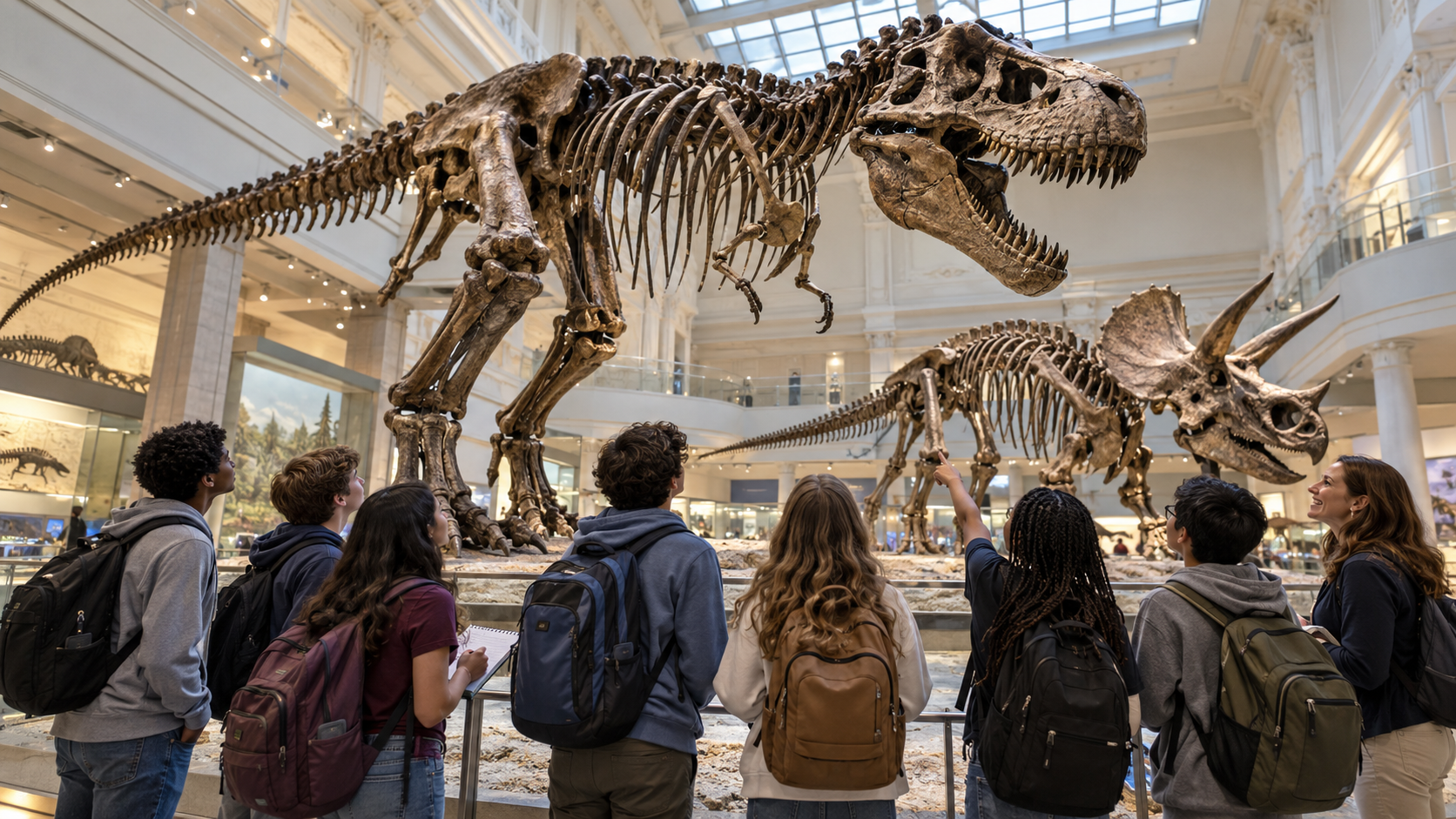
Dinosaurs. Mammals. The Hope Diamond. This museum is a guaranteed win with middle schoolers in a way almost nothing else on the Mall is. The Fossil Hall — with a T. rex facing off against a Triceratops — holds a crowd of teenagers in genuine silence, which anyone who has chaperoned teenagers will appreciate.
Why it works for 8th graders: Middle school science covers earth science, ecosystems, and evolution; the museum's halls map directly onto those units. The Ocean Hall gives you climate and marine biology in one sweep.
Pacing: 90 minutes, anchored on the Fossil Hall. Send small chaperoned groups with a scavenger-hunt style mission rather than letting students wander.
Tip: The butterfly pavilion requires a separate timed ticket and has limited capacity — decide in advance whether it's worth the logistics for your group size.
3. National Museum of American History — the curriculum tie-in
This is the sleeper pick. It doesn't have the spectacle of Air and Space, but it has the single artifact that connects most directly to an 8th-grade classroom: the original Star-Spangled Banner, the actual flag that flew over Fort McHenry in 1814.
Why it works for 8th graders: The "Price of Freedom: Americans at War" exhibition walks through every conflict from the Revolution forward — a powerful companion to a U.S. history unit. The First Ladies' gowns and the "American Presidency" gallery give students a human window into the civics they're studying. For how a D.C. trip reinforces classroom standards, see how a D.C. trip maps to 8th-grade civics standards.
Pacing: 75–90 minutes. The museum is huge; anchor on two or three exhibitions and skip the rest.
Tip: "The Star-Spangled Banner: The Flag That Inspired the National Anthem" gallery is dimly lit to preserve the flag — it reads as reverent, not boring, if you frame it for students beforehand.
4. National Museum of African American History and Culture — the powerful one
The newest museum on the Mall is also one of the most profound. It tells the full arc of the African American experience, from the Middle Passage through the Civil Rights Movement to the present. It is, frankly, the museum students talk about most on the bus ride home.
Why it works for 8th graders: The history exhibitions begin underground, in the hold of a slave ship — a visceral, unforgettable design choice — and ascend through emancipation, Reconstruction, and the Civil Rights Movement. Students who studied Rosa Parks and Martin Luther King Jr. in elementary school meet them here as part of a much larger story. Plan for this to be the emotional centerpiece of your museum day, not a stop squeezed between two others.
Pacing: Two hours minimum; this museum deserves more time than the others and more decompression afterward. Build in a quiet walk or journaling time after the visit.
Tip: This museum requires a timed-entry pass, and they go fast — often weeks out. When you plan 8th grade D.C. trips with Son Tours, we secure those passes for you as part of the itinerary.
The practical rules every teacher needs
Admission is free — but timed passes aren't optional. Several museums (African American History and Culture, the Holocaust Memorial Museum, and periodically others) require free timed-entry passes reserved in advance. Spring is peak school-group season; the passes that matter disappear fast. Son Tours handles all timed-entry bookings for our groups, so your teachers never have to sit on a website at 7 a.m. refreshing a calendar.
The 90-minute rule. Middle schoolers get real museum value for about 90 minutes, then attention collapses. Plan one museum deeply rather than two superficially. A focused 90 minutes with a mission — find three artifacts, answer one guiding question — beats a three-hour death march.
Lunch logistics. The museum cafeterias on the Mall are expensive, crowded, and slow for groups of 40+. Plan lunch off-site or at a pre-arranged spot. A group-friendly lunch spot within walking distance saves an hour of chaos — and we build that into every itinerary.
Pair museums with the night tour. Museums are the daytime anchor; the D.C. monuments at night are the emotional anchor. That pairing — learning by day, awe by night — is what makes student trips to D.C. stick for years.
Planning a museum day that actually works
Four museums, four distinct payoffs: wonder, science, curriculum, and conscience. You don't need all four on every trip — pick the two or three that fit your learning goals, pace them at 90 minutes each, and leave the Mall while the students are still happy.
With Washington D.C. student tours from Son Tours, museum days are planned around your curriculum, timed-entry passes are handled in advance, and a private uniformed security professional travels with your group at no extra cost. Ready to start planning? Request a quote and we'll build the itinerary around your students.
