
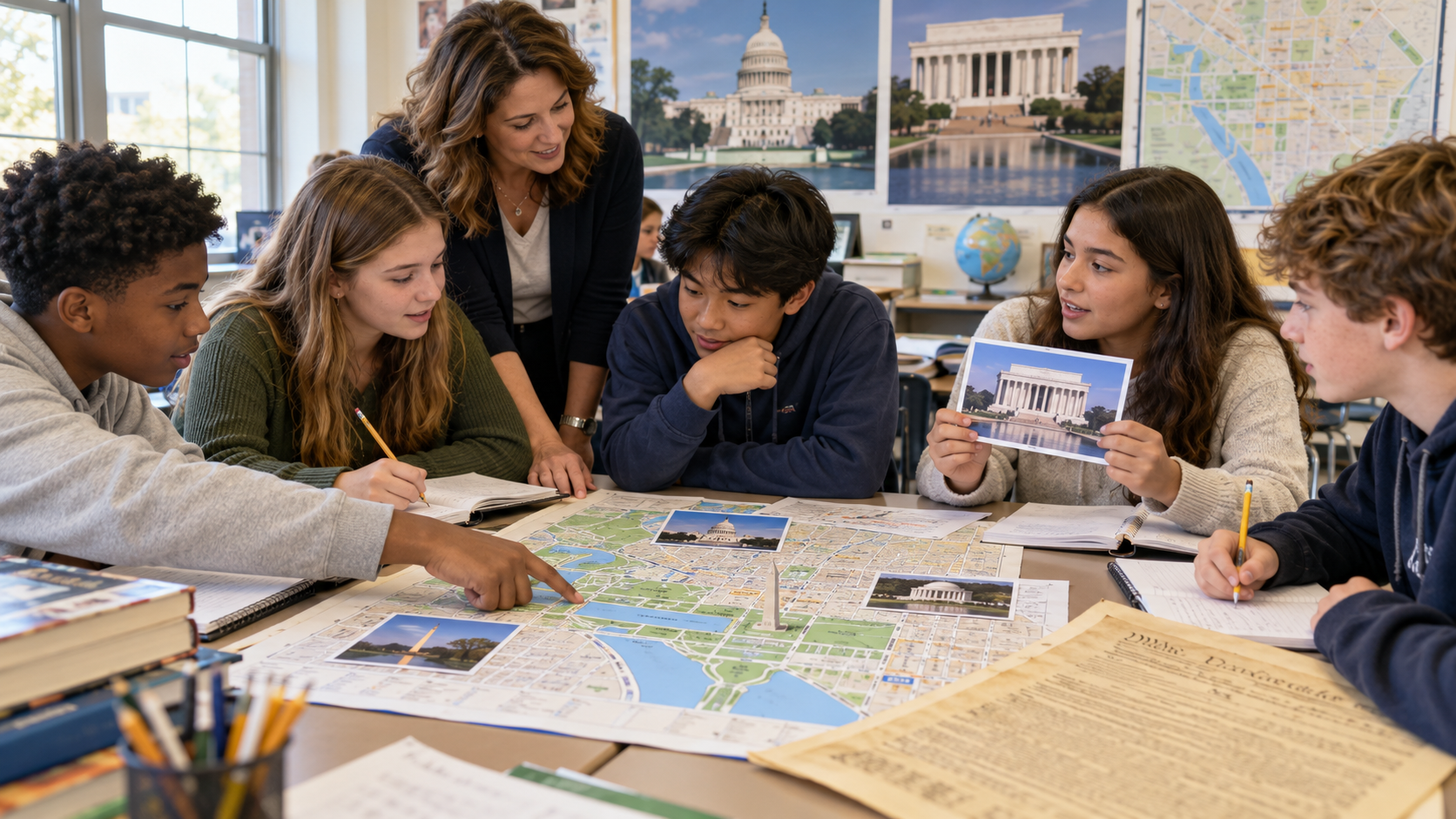
Pre-trip activities help students arrive in Washington with questions, context, and ownership of the sites they will visit. The highest-value options are a founding-document close read, student-led memorial research, a three-branches site map, and a question journal used throughout the trip.
The difference between a good D.C. trip and an unforgettable one is what happens in your classroom before the bus leaves. Students who arrive with background knowledge, personal connections to the sites, and a sense of purpose don't just see Washington D.C. — they read it. Here are eight teacher-ready pre-trip activities, each tied to a real stop on the itinerary.
1. Charters of Freedom close-read
Tied to: the National Archives.
In the week before the trip, have students do a close read of one founding document — the Declaration, the Constitution's preamble, or a selected amendment — using a primary-source analysis routine (observe, reflect, question). They annotate, they argue about meaning, they write down one question the document raises for them. Then, when they stand in the Rotunda of the Archives looking at the actual parchment, the document isn't new — it's an old friend they've already debated. In 2026, America's 250th year, this activity carries particular weight: your students are reading the words at the semiquincentennial of the nation they built.
2. Adopt a memorial
Tied to: the National Mall memorials.
Assign each student (or small group) one memorial you'll visit — Lincoln, Vietnam Veterans, WWII, Korean War, MLK Jr., FDR, Jefferson. Their job: research who it honors, why it was built, one design detail with symbolic meaning, and one story connected to it. They become the group's "expert" at that stop and give a two-minute briefing when you arrive. Suddenly the memorials aren't a blur of marble — they're eight stories your students own. This pairs naturally with the standards mapping in our guide to how a D.C. trip maps to 8th-grade civics standards.
3. Map the three branches to D.C. sites
Tied to: the Capitol, the White House, the Supreme Court.
Give students a blank map of central D.C. and have them plot the three branches of government onto the physical city: Congress at the Capitol, the presidency at the White House, the judiciary at the Supreme Court. Add the Archives as "the founding documents" and the memorials as "civic virtue." This spatial mapping builds a mental model before the trip — when the bus turns a corner and the Capitol appears, students already know what they're looking at and why it matters. It's also a ready-made artifact for your principal's trip proposal.
4. Veteran interview and oral history (before Arlington)
Tied to: Arlington National Cemetery, the war memorials.
If your itinerary includes Arlington — and it should — this is the most powerful pre-trip activity you can run. Have students interview a veteran in their family or community: Where did you serve? What do you remember most? What would you want young people to understand about service? Students record the interview (audio or written) and bring one quote with them to Arlington. When they watch the Changing of the Guard or participate in a wreath-laying, they're not observing an abstract ceremony — they're carrying someone's story into it. If you're planning the ceremony itself, our walkthrough of how to arrange a wreath-laying ceremony at Arlington covers the logistics.
5. Monument symbolism art analysis
Tied to: the Lincoln Memorial, the Jefferson Memorial, the Washington Monument.
Treat the memorials as art. Project high-resolution images and have students analyze them like visual texts: Why 36 columns on the Lincoln Memorial? Why does the statue face east toward the Capitol? What's the symbolism of the Washington Monument's two-tone stone? Students learn that these buildings are arguments in stone — and when they arrive in person, they'll read details other visitors walk right past. This works especially well as a cross-curricular activity with your art teacher.
6. The logistics lesson: packing and planning
Tied to: the whole trip.
Turn trip prep into a practical life-skills lesson. Students build their own packing lists against a weather forecast for D.C. in your travel month, calculate walking distances between sites on the itinerary, and budget a small amount of souvenir money. They learn to read a transit map, convert a schedule into a plan, and take ownership of their own readiness. Teachers who do this report fewer forgotten items, fewer complaints, and students who feel like travelers rather than cargo. And when middle school trips to Washington D.C. involve 80+ students, every bit of student self-sufficiency helps the chaperones.
7. "One question" journal
Tied to: every stop.
Give each student a small trip journal — physical or digital — with one instruction: before each major site, write down one question you want that site to answer. "What did the founders actually disagree about?" at the Archives. "Who decides what a memorial looks like?" at the Mall. "How does a bill become a law, really?" at the Capitol. During the visit, they hunt for their answer. After the trip, the journal becomes the raw material for reflections and presentations — see our guide to post-trip assignments that prove educational value. One question per site turns sightseeing into inquiry.
8. The 250th connection: "What does 250 mean to you?"
Tied to: the 2026 America's 250th programming.
Your students are traveling to D.C. during the semiquincentennial — something that happens once in a lifetime. Have them write a short piece before the trip: what does 250 years of American democracy mean to a 13-year-old? They'll revisit it after the trip, and the before/after comparison is one of the most revealing assessments you'll ever collect. It also builds genuine excitement: they're not just going to D.C., they're going during the biggest birthday the country has ever thrown, and our guide to what student groups need to know about America's 250th in D.C. will help you plan around the programming.
Making it all fit
You don't need all eight. Pick three or four that match your curriculum and your calendar — the close-read and the "one question" journal are the highest-leverage pair if you're short on time. The point is the same either way: background knowledge before the trip multiplies the learning during it, and the documentation it produces (journals, interviews, expert briefings) becomes the evidence of educational value your administrators want to see.
Frequently Asked Questions
-
Teach the essential historical context, preview major sites, assign each student a question or research role, and review behavior and security expectations. Preparation should create curiosity rather than duplicate the tour.
-
Have students closely read one founding document, annotate its language, and write a question they want the original document to answer. Revisit that question in the Archives Rotunda.
-
Map the Capitol, White House, Supreme Court, Archives, and memorials to branches of government, founding principles, civic participation, and public memory before students travel.
-
A few focused lessons can be enough. If time is limited, choose one document activity, one student research assignment, and a question journal that continues during and after the trip.
Plan the Next Step
Use this guide to clarify your priorities, then compare dates, inclusions, and responsibilities in writing. Explore Son Tours’ Washington, D.C., student trips or request a school-specific quote when you are ready to turn the research into an itinerary.
