
The best post-trip assignments require students to use evidence from what they saw, connect it to civics or history standards, and explain how the in-person experience changed their understanding. Photo essays, podcasts, civic-action proposals, document reflections, and public presentations also give administrators visible proof of learning.
The trip is over. The buses are home, the permission slips are filed, and now your principal asks the question that decides whether this becomes a tradition or a one-time event: What did the students actually learn?
This is the ROI conversation, and the teachers who win it are the ones who planned the evidence before the trip — starting with the pre-trip classroom activities that gave students something to build on. Here are seven post-trip assignments that turn a D.C. field trip into measurable, demonstrable, board-meeting-ready learning.
1. The photo-essay reflection
Each student selects five photos from the trip and writes a short essay connecting them: what did these five moments teach you about American democracy that a textbook couldn't? The constraint of five photos forces selection and synthesis — students have to decide what mattered most and articulate why. The best of these make powerful displays for parent nights and school board presentations, because they show learning in the students' own words and images.
2. "Letter to a founder" at the Archives
Tied to: the National Archives, Charters of Freedom.
Students write a letter to one of the founders — Madison, Jefferson, Adams, take your pick — responding to something they saw in the Rotunda. What surprised you about the actual document? What question would you ask the person who wrote it? What would you tell them about how their words have held up after 250 years — especially resonant during America's 250th anniversary year? This assignment practices historical empathy and evidence-based writing at once, and it produces work students are genuinely proud of.
3. Memorial podcast episode
In pairs, students produce a short (5–8 minute) podcast episode about one memorial they visited — its history, its symbolism, and one personal reflection on standing there. They can record on a phone; the bar is storytelling, not production value. The format forces them to organize research into a narrative and speak with conviction. Play the best episodes for the class, and you've got an assessment that's also a celebration. If students did the "adopt a memorial" research before the trip, this is its natural sequel.
4. Civic-action proposal
The trip shows students how government works. This assignment asks: now what? Each student identifies one issue they care about — in their school, their neighborhood, or their city — and writes a formal proposal for action: the problem, the evidence, who has the power to fix it, and the specific steps they'd take. It's the citizenship standard made real: the trip taught them that ordinary people shape the republic, and this is their first draft of doing it. Administrators love this one, because it demonstrates the trip's effect on civic engagement — the hardest outcome to fake.
5. Comparison essay: textbook vs. the Rotunda
Students write a structured comparison: what did the textbook say about a topic (the founding, the Civil War, the civil rights movement), and what did standing in the actual place add, change, or complicate? This is historical thinking at its best — weighing sources, recognizing that place is a kind of evidence, and articulating the difference between knowing about something and encountering it. It also directly answers the "why travel?" question: the essay itself is the proof that the trip did something no classroom could.
6. The "one question" journal, answered
If students kept a pre-trip "one question" journal — one question per site, to be answered during the visit — the post-trip version writes itself. Students return to each question and write the answer the site gave them, with evidence from what they saw. Collect the journals and you have a complete, individualized record of inquiry across the entire trip. For grading, a simple rubric works: quality of the original questions, evidence cited in the answers, and depth of reflection.
7. Group presentation: teach the school
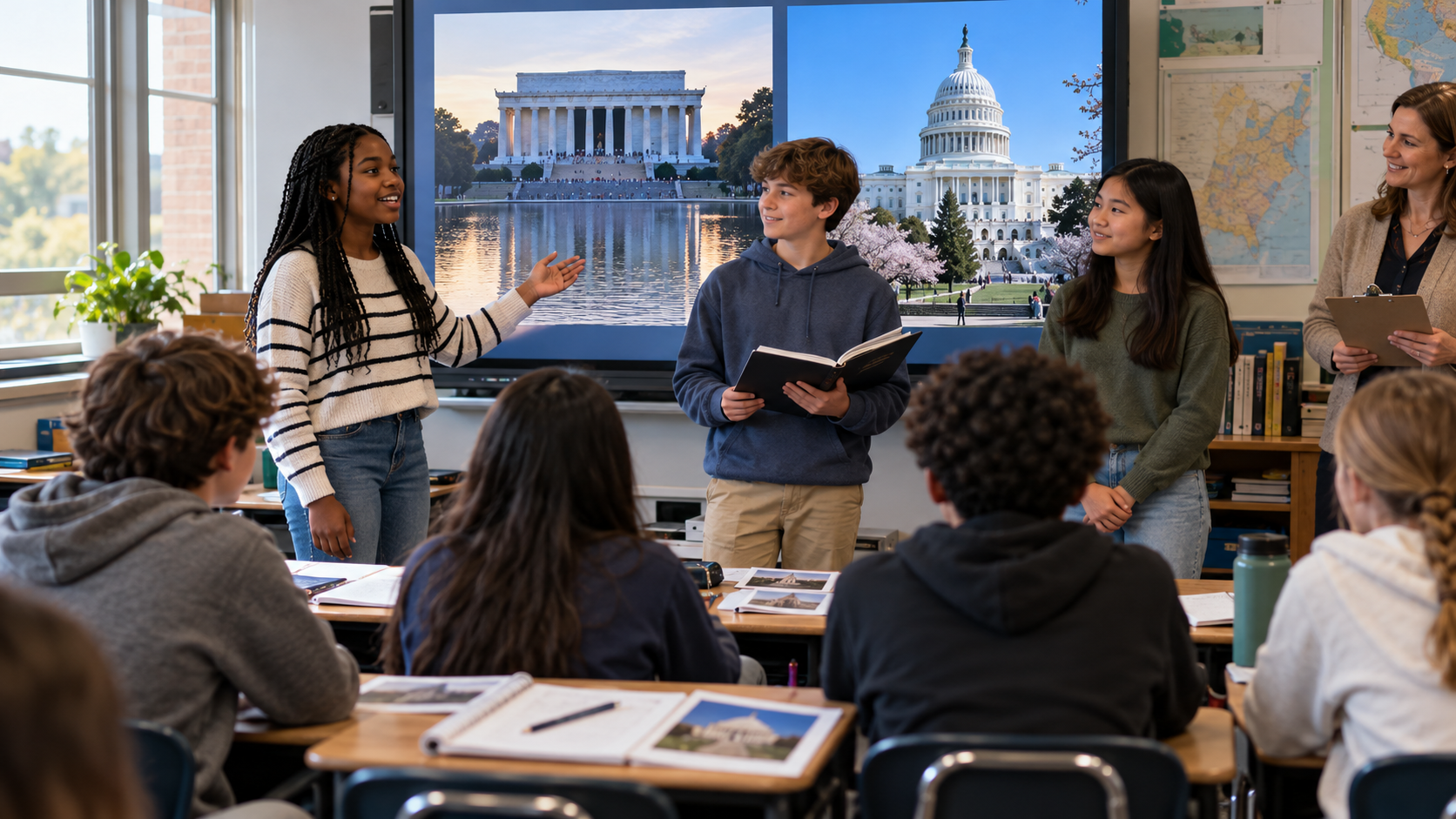
Small groups each take one stop from the itinerary and build a 10-minute presentation for another class, a parent night, or the school board: what the site is, why it matters, and what your group learned there. Teaching is the highest form of mastery, and the public-facing element raises the stakes in the best way — students prepare harder when the audience is real. Record the presentations and you've got trip documentation that does double duty as marketing for next year's trip.
Packaging the evidence for your administration
Assignments alone don't win the ROI argument — presentation does. Here's how to package it:
· Build a trip portfolio for your principal: the best photo essays, two or three podcast episodes, and a one-page summary connecting the trip to your 8th-grade civics standards.
· Present at a board meeting with student work, not just your summary. A student reading their "letter to a founder" does more than any spreadsheet.
· Track the tradition. Schools that run the trip annually can show compounding value: returning chaperones, growing enrollment in the trip, alumni who cite it as formative. That's the 96% retention story — schools don't just come back to Son Tours, they build the trip into their identity.
Why the operator matters for the learning, too
Educational value doesn't happen by accident on a student trip — it happens when the itinerary is built around your curriculum, the days run on schedule so the learning time is protected, and the students feel safe enough to actually engage. That's why Son Tours builds fully customizable, curriculum-aligned itineraries around what you're teaching, includes private uniformed security at no extra cost, and assigns your school one dedicated coordinator from planning through the final day. A veteran-led team (founders: former intelligence officer along with the Army, 82nd Airborne) with 30+ years of experience, SYTA membership, and an A+ BBB rating doesn't just move students through D.C. — it protects the conditions that make the learning possible.
Frequently Asked Questions
-
A five-photo essay works well because students must choose meaningful moments and connect each one to a civics or history idea. Require specific evidence rather than a simple trip recap.
-
Use a clear rubric tied to curriculum standards, primary sources, site observations, and student reasoning. The assignment should show what students understood because they were physically present.
-
Students can produce podcasts, letters to historical figures, civic-action proposals, comparison essays, journals, exhibits, or presentations for families and the school board.
-
Collect representative student work, map it to standards, present it publicly, and retain a trip portfolio for future approval and fundraising. Student evidence is more persuasive than a general claim that the trip was educational.
Plan the Next Step
Use this guide to clarify your priorities, then compare dates, inclusions, and responsibilities in writing. Explore Son Tours’ Washington, D.C., student trips or request a school-specific quote when you are ready to turn the research into an itinerary.
