
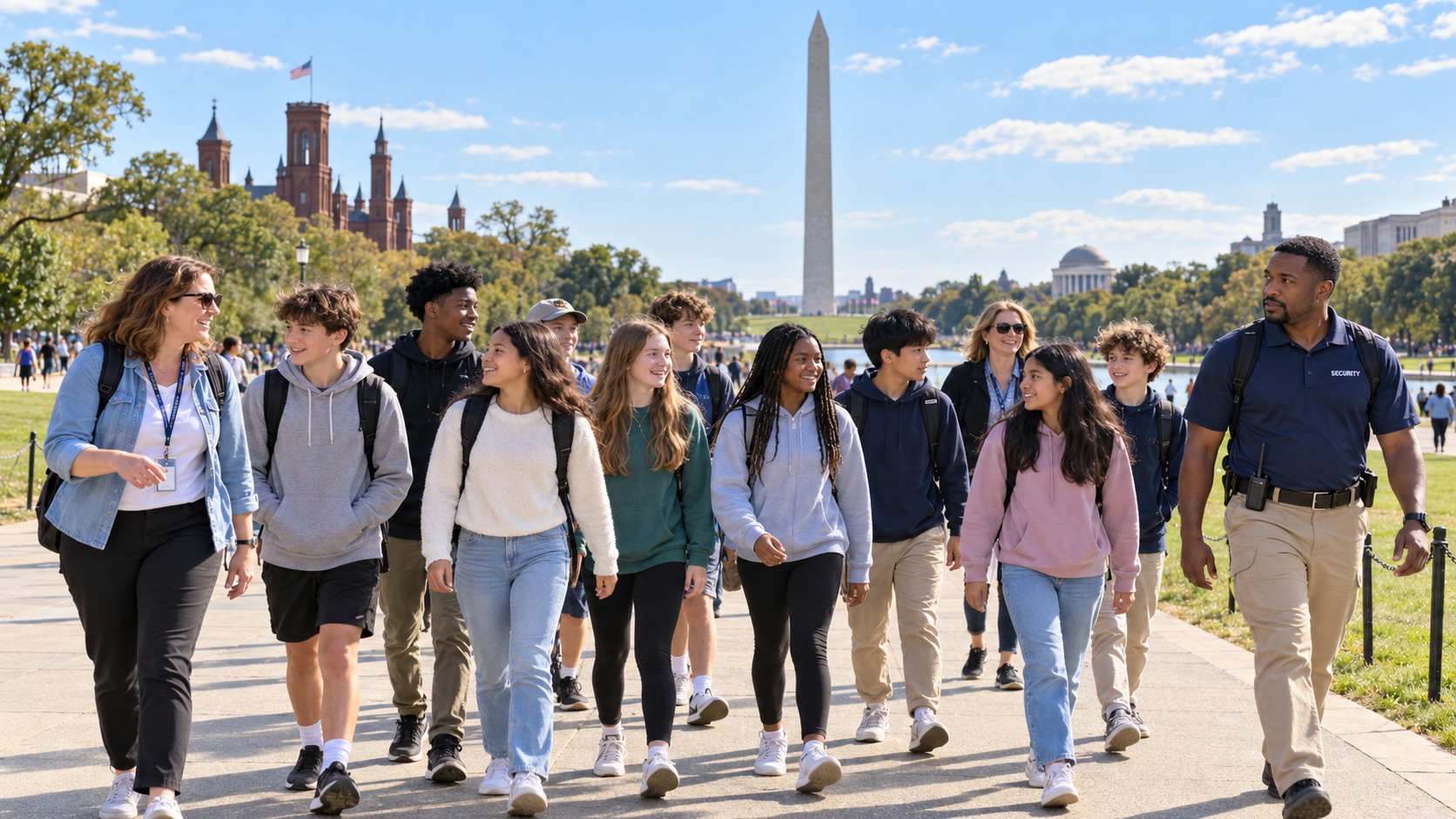
Washington, D.C., can be a safe destination for student groups when the trip uses vetted lodging and routes, clear supervision, reliable transportation, trained on-site support, and written emergency procedures. Safety depends less on a blanket description of the city and more on how the group’s specific itinerary is planned and managed.
If you're the teacher or parent volunteer planning your school's trip to the nation's capital, this is the question that keeps you up at night. And it's the right question to ask. So let's answer it honestly.
The honest answer: D.C. is a major city — and the student corridor is extremely well managed
Washington D.C. is a large, living city with real neighborhoods, rush-hour traffic, and all the complexity that comes with a population of 700,000 people. Anyone who tells you otherwise isn't being straight with you.
But here's the part that matters for your planning: the places student groups actually go — the National Mall, the Smithsonian museums, the memorials, the Capitol campus — sit inside one of the most heavily policed, visitor-friendly corridors in the country. The National Mall is patrolled by U.S. Park Police. The museums have their own security teams. The Capitol grounds are watched by Capitol Police. The areas where students spend 90% of their trip are, by design, the safest and most supervised parts of the city.
That's why thousands of schools bring middle school trips to Washington D.C. every year without incident. The trip is safe not by accident, but because of careful planning — the right routes, the right hotels, the right supervision, and the right people on the ground.
Why parent anxiety is really about planning, not the city
When a parent says "I'm not sure D.C. is safe," what they're really asking is: Will someone I trust be watching my child at every moment? Is there a plan if something goes wrong? Does the operator doing this trip actually know what they're doing?
Those are the right questions. A generic itinerary and a bus driver who has never been to the city don't answer them. A veteran-led operation does. Son Tours was founded by former intelligence and Army professionals — 82nd Airborne — and every itinerary we run is vetted for safety by people who did this kind of work professionally before they ever touched educational travel. With 30+ years in business and a 96% client retention rate, our clients keep coming back because the safety piece isn't a promise. It's the product.
What "safe" actually looks like on a Son Tours D.C. trip
Safety on a student trip isn't one thing. It's a system. Here's what's built into every one of our Washington D.C. student tours:
Private uniformed security, included at no extra cost. Most operators either charge a premium for security or don't offer it at all. We include a private uniformed security presence with every group — during the day at major sites and at the hotel at night. Our security teams are led by veterans and trained professionals who do advance work on your routes, coordinate arrivals at monuments and museums, and monitor hotel floors after curfew. You can read exactly what they do behind the scenes in our walkthrough of what private security actually does on a student D.C. trip.
One dedicated coordinator per school — no call centers. From planning through the final day of the trip, your school has a single coordinator who knows your group by name. If a parent has a concern at 10 p.m. two weeks before departure, they're not calling a 1-800 line. They're calling their person. That coordinator travels with you and is the central point for chaperones, drivers, and security throughout the trip.
Vetted hotels and routes. We don't book whatever hotel has availability and hope for the best. Every hotel we use has been evaluated for location, floor layout (so your group can be clustered together), after-hours security, and emergency egress. Routes between sites are chosen for pedestrian safety and supervision — crossing points, walking distances, and rally points are planned before your students ever step off the bus.
Pre-trip safety briefings. Before departure, your coordinator walks chaperones through roles, buddy systems, communication plans, and emergency protocols. Students get an age-appropriate briefing too, so expectations are set long before anyone is standing on the Mall. Our guide to chaperone ratios and roles on a D.C. trip goes deeper on how supervision is structured.
Emergency protocols that are real, not theoretical. Every trip carries documented emergency procedures: hospital routing, lost-student protocols, severe weather plans, and direct liaison lines to local law enforcement. Our security personnel coordinate with local agencies so response times are measured in minutes, not confusion.
The 2026 factor: America's 250th and bigger crowds
2026 marks America's 250th birthday, and D.C. is the epicenter of the celebration. That means larger crowds, more events, and more energy around the Mall and memorials — which is exactly why this is a trip worth taking, and exactly why the operator you choose matters more this year than ever. Bigger crowds demand better crowd planning: timed entries, alternate routes, earlier arrivals, and security staff who read a crowd the way professionals do. This is what we do. Schools are planning their spring trips right now for the fall booking cycle, and groups that book early get the best itineraries around the 250th programming.
A note you can forward to nervous parents
If you're a teacher reading this, here's the paragraph for the parents who are on the fence:
Washington D.C.'s tourist corridor — where your child will spend nearly all of the trip — is one of the most supervised visitor areas in the United States. Son Tours, our operator, is a veteran-owned company (founders: former CIA and Army, 82nd Airborne) with 30+ years of experience, SYTA membership, and an A+ BBB rating. They provide private uniformed security at no additional cost, assign one dedicated coordinator to our school, and vet every hotel and walking route before we travel. If you'd like to see a detailed picture of a typical trip, here's their sample 3-day middle school D.C. itinerary.
The bottom line
Is Washington D.C. safe for student groups? With the right operator, yes — decisively yes. The city core where students spend their time is heavily policed and purpose-built for visitors. And when the operator is veteran-led, includes private security at no extra cost, vets every detail in advance, and assigns your school a dedicated coordinator, "safe" isn't a hope. It's the plan.
Frequently Asked Questions
-
Thousands of students visit the city, and the major educational sites have substantial public security. Schools still need strong supervision, vetted logistics, current local awareness, and an emergency plan.
-
Most school itineraries focus on the National Mall, Smithsonian museums, Capitol Hill, Arlington National Cemetery, and major memorials. Hotel location and travel routes should be evaluated separately.
-
Ask who supervises students during the day and overnight, how hotels and routes are selected, what happens during separation or illness, who communicates with families, and whether trained security is included.
-
Use subgroup rosters, emergency contacts, medical information protocols, rally points, communication trees, backup routes, and written decision authority. Review the plan with staff and chaperones before departure.
Plan the Next Step
Use this guide to clarify your priorities, then compare dates, inclusions, and responsibilities in writing. Explore Son Tours’ Washington, D.C., student trips or request a school-specific quote when you are ready to turn the research into an itinerary.
