
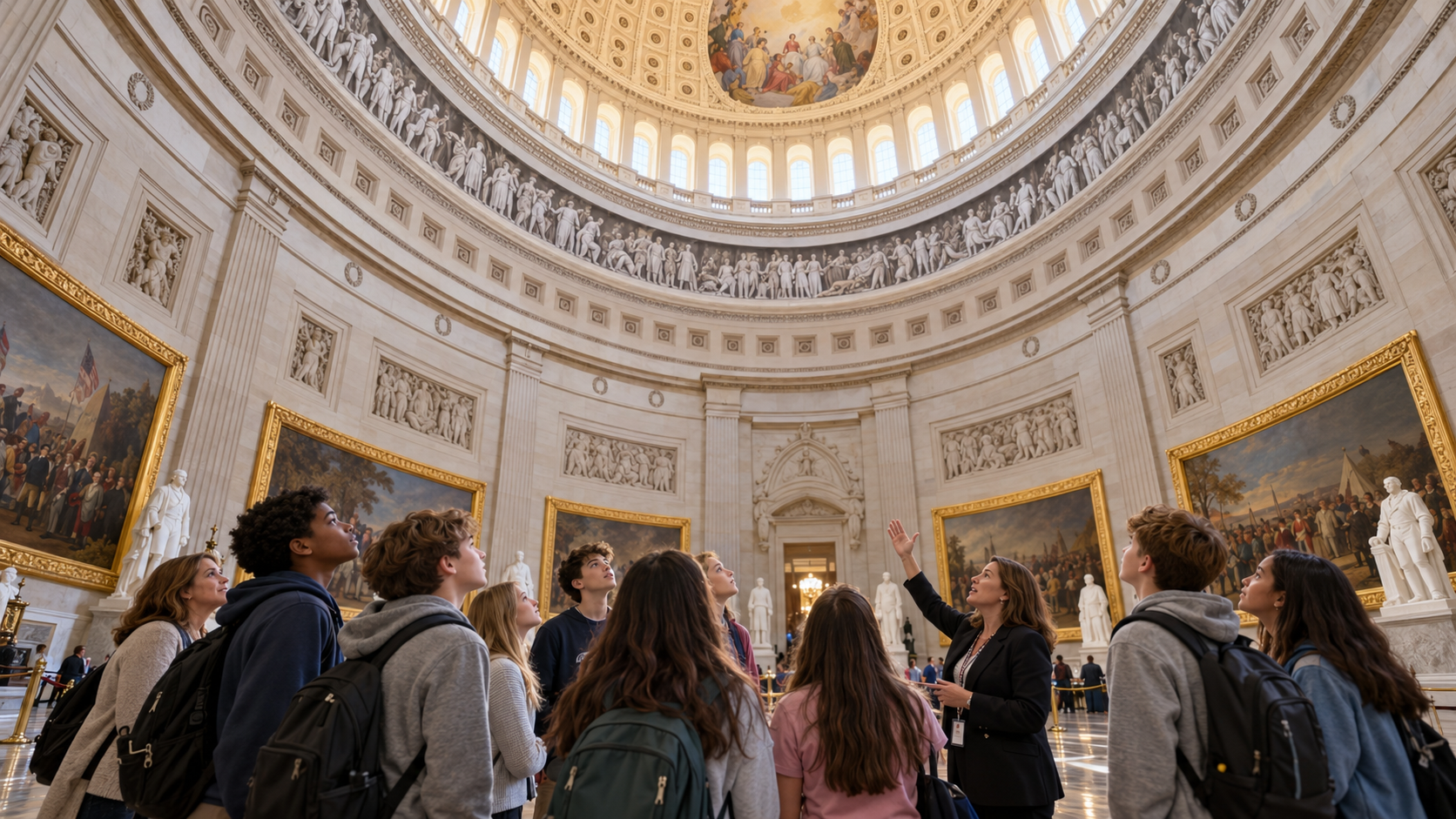
Capitol and White House tours require advance requests, and the processes are different. Capitol tours may be booked through the Capitol Visitor Center or a congressional office; public White House tour requests must go through a member of Congress and remain subject to availability and security approval.
For many students, the U.S. Capitol is the moment D.C. becomes real. They've seen the dome in textbooks since elementary school; standing under it, in the Rotunda, looking up at the fresco 180 feet above — that's when "the government" stops being an abstraction.
But here's what first-time planners learn the hard way: you can't just show up. Capitol and White House tours for school groups run through congressional offices, on timelines that reward early planners and punish procrastinators. Here's exactly how it works.
Touring the U.S. Capitol with students
How to book: Public tours of the Capitol are free and can be reserved through the Capitol Visitor Center — but school groups get a significantly better experience booking through their Representative's or Senator's office. Congressional staff can arrange guided tours led by their own office staff, which are more personal, more flexible on group needs, and often include access the standard tour doesn't.
How far ahead: Request 2–3 months out at minimum. Spring is the highest-demand season in Washington — every 8th grade class in America seems to descend on the Capitol in April — and congressional tour slots fill accordingly. If your trip is in March, April, or May, earlier is better. Fall planners booking spring trips have the advantage here; use it.
What students will see: The standard tour covers the Rotunda (the symbolic heart of the Capitol, with its massive paintings of Revolutionary scenes), and National Statuary Hall. If your Representative's office arranges the tour, ask about the House or Senate galleries — watching Congress in session, even briefly, is electric for students studying civics. Gallery passes are also available through congressional offices and are worth requesting separately.
Curriculum payoff: The Capitol visit is the single best on-the-ground reinforcement of an 8th-grade civics unit — separation of powers, representative democracy, federalism. For help connecting the dots, see how a D.C. trip maps to 8th-grade civics standards.
Touring the White House with students
How to book: White House tours are requested exclusively through your Representative's or Senator's office — there is no public booking line, no website reservation, no walk-up option. You submit a tour request to your congressional office, which forwards it to the White House Visitors Office.
How far ahead: As early as possible. White House tour availability is genuinely limited — far more limited than the Capitol — and requests are granted on a rolling basis. For a spring trip, submitting your request in the fall (or even late summer) is the smart move. Congressional offices will tell you their own deadlines; some want requests six months out. Take them at their word.
Set expectations honestly: White House tours are self-guided, relatively brief (about 45 minutes), and cover the public rooms of the East Wing — the Blue Room, Red Room, Green Room, State Dining Room. Students won't see the Oval Office. It's still the White House, and students still love it — but frame it accurately so no one is disappointed.
A practical note: White House tour confirmations often arrive close to the trip date, sometimes just days before. Build your itinerary so the White House is a highlight, not a load-bearing wall — have a strong backup plan for that time slot in case the confirmation doesn't come through.
Excellent backups: the Library of Congress and the Supreme Court
Smart planners line up alternatives, because congressional tour slots and White House confirmations don't always cooperate. The good news: two of the best student stops in D.C. are right next door and far easier to arrange.
The Library of Congress — directly across the street from the Capitol, connected by an underground tunnel — is stunning. The Thomas Jefferson Building's Great Hall, with its marble, murals, and soaring ceilings, gets audible gasps from teenagers. The Main Reading Room overlook is a favorite photo stop. Free timed-entry passes are released in advance; they're far easier to get than White House tours and the payoff-per-minute is reasonably higher.
The Supreme Court — one block east of the Capitol — offers courtroom lectures when the Court isn't in session, plus exhibits on landmark cases students actually study (Brown v. Board, Miranda, Tinker). For a civics-focused trip, the Court completes the three-branches trifecta: Capitol (legislative), White House (executive), Supreme Court (judicial). All within a few blocks.
A Capitol Hill day that runs Capitol → Library of Congress → Supreme Court is one of the strongest single days you can build on middle school trips to Washington D.C.. See our sample 3-day middle school D.C. itinerary for how we sequence it.
Security screening with a group of 13-year-olds
Every one of these buildings means security screening — magnetometers, bag checks, the works. With 40+ middle schoolers, this is a logistics exercise, not a formality. What works:
· Brief students the night before. Empty pockets before you reach the checkpoint. No pocketknives (yes, really — they get confiscated weekly), no large bags, no food or drink in most buildings.
· Consolidate bags. The fewer bags going through the scanner, the faster your group moves. Chaperones carry the essentials; students carry as little as possible.
· Budget the time. Screening a large student group takes 20–30 minutes at the Capitol Visitor Center. Build it into the schedule instead of discovering it.
· Keep the group together after screening. Students scatter on the other side of checkpoints. Designate a rally point inside, and do a headcount before moving on.
This is routine for an experienced operator and chaos for a first-timer. Son Tours' itineraries are built with screening times baked in, and your group's private uniformed security professional — included at no extra cost — helps keep the group organized through every checkpoint.
Let someone else manage the congressional requests
Here's the part teachers don't expect: requesting Capitol and White House tours means identifying your Representative and Senators, finding the right staffer, submitting formal requests on the office's timeline, following up, and tracking confirmations that arrive at different times. It's real administrative work, on top of everything else you're doing to plan the trip.
Son Tours coordinates these requests for our school groups — the congressional outreach, the follow-ups, the backup planning, the day-of sequencing. Your dedicated coordinator (one person who knows your school, not a call center) handles it as part of building your itinerary.
Frequently Asked Questions
-
Groups can check the Capitol Visitor Center’s current reservation process or contact their member of Congress for assistance. Ask separately about gallery access because it may require passes from a congressional office.
-
U.S. citizens submit public tour requests through their member of Congress. Requests are not guaranteed, and schools should maintain a strong backup plan until confirmation is received.
-
Submit within the current official request windows as early as your dates allow. Rules and timelines can change, so confirm them with the official visitor offices and your congressional representative.
-
Bring only permitted items, consolidate bags, allow extra time, and establish a regrouping point after screening. Review the latest prohibited-items guidance shortly before travel.
Plan the Next Step
Use this guide to clarify your priorities, then compare dates, inclusions, and responsibilities in writing. Explore Son Tours’ Washington, D.C., student trips or request a school-specific quote when you are ready to turn the research into an itinerary.
