
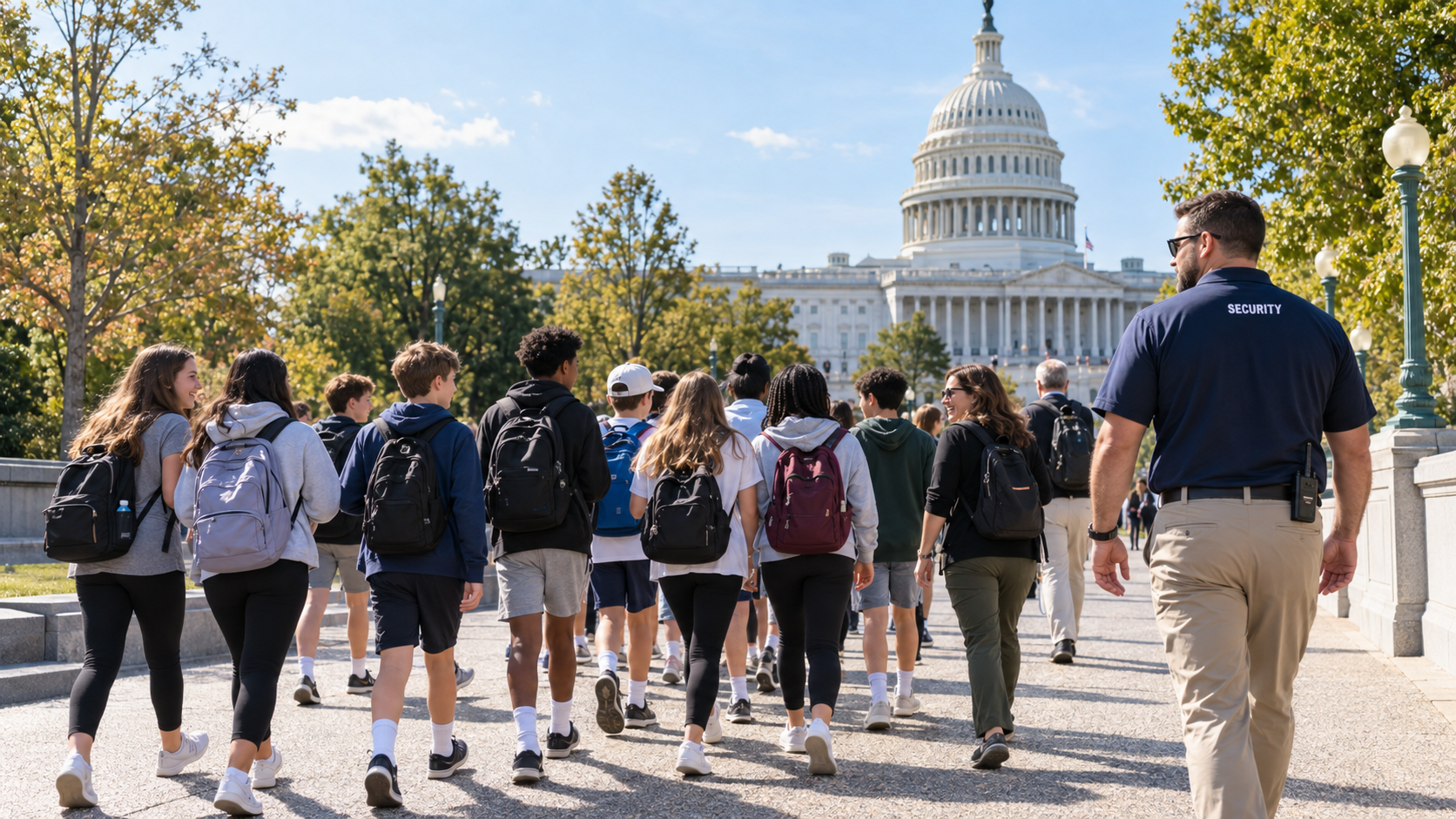
Private security on a student D.C. trip should involve more than visible presence. Meaningful coverage includes advance route and hotel review, coordination at busy sites, support during group movement, overnight monitoring, communication with local authorities when needed, and practiced emergency procedures.
"Private security included" sounds impressive on a brochure. But what does it actually mean, hour by hour, on a three-day trip with 100 eighth graders in the nation's capital? Here's the behind-the-scenes walkthrough — because if you're comparing operators, the details are where the difference lives.
Before your group arrives: advance work
The security work starts long before the first student boards a bus. Son Tours' security team — led by veterans and trained professionals, with company roots in former intelligence officer and Army (82nd Airborne) professionals — reviews your itinerary the way intelligence professionals review an operation: what's the plan, what could complicate it, and what's the backup?
That means advance vetting of walking routes between sites: crossing points, construction zones, crowd choke points, and rally locations if a group needs to regroup quickly. It means confirming hotel floor assignments so your students are clustered together, near chaperones, with stairwell and elevator access mapped. It means checking museum and memorial schedules for closures, protests, or special events that could shift timing — and adjusting the plan before you ever feel the disruption.
Most student tour operators do none of this, or they charge a premium for "security packages." Son Tours includes private security with every group at no extra cost. That's not a promotional add-on. It's how the company was built.
During the day: arrival coordination and site supervision
On the ground, Son Tours coordinator’s first job every morning is presence.The Son Tours coordinator is with the group at all the sites — the Capitol, the museums, the memorials, Arlington — and their job is coordination, not crowd control.
When your group arrives at a monument or museum, your coordinator has already confirmed the arrival logistics: where the buses stage, which entrance the group uses, and how students move from the bus to the doors in one supervised flow. Inside museums, they work the perimeter of the group — the adults stay inside the flow while security watches the edges, entry points, and exits. At the memorials, where groups are outside and spread across open ground, the coordinator maintains sightlines across the group and keeps headcounts tight at transitions.
They also run the timing. Big days in D.C. live or die on transitions, and the 2026 America's 250th celebrations mean bigger crowds than usual around the Mall and memorials. Your Son Tours coordinator knows which sites run long, where bottlenecks form, and when to shift a lunch stop or reorder two sites to keep the day smooth. If you're wondering how this fits into the overall schedule, our sample 3-day middle school D.C. itinerary shows how a day is structured — and the security layer is the reason it stays on track.
Liaison with local law enforcement
This is the piece you can't see and shouldn't have to think about. Son Tours' personnel maintain working relationships with the agencies that actually police the student corridor: U.S. Park Police on the Mall, Capitol Police around the Capitol complex, and local law enforcement along routes and near hotels.
What that means in practice: if there's a demonstration, a road closure, or a security incident anywhere near your group's path, your team knows about it in real time — often before it affects the public flow — and reroutes around it. If there's an emergency, the team isn't calling a general number and explaining who they are. They're reaching people they already know, with your group's location already in hand.
At the hotel: night watch and floor monitoring
The part parents ask about most: nighttime. After the group returns to the hotel and curfew is set, the security posture shifts to the hotel.
Security monitors the floors where your students are housed — not just individual rooms, but the hallways, stairwells, and elevator landings. Students stay on their floors; visitors who don't belong don't get past the lobby unnoticed. Chaperones handle their assigned students; security handles the perimeter. It's a quiet, professional presence that lets the adults actually sleep, which means the next day's supervision is sharp instead of exhausted.
Hotels are chosen in advance with exactly this in mind: group-friendly floor plans, secure access points, and locations in areas our team has vetted. If you're building your chaperone team, pair this with our guide to chaperone ratios and roles on a D.C. trip — security and chaperones are two halves of the same plan.
Emergency protocols: planned, documented, practiced
Every Son Tours trip carries documented emergency procedures, and the security team owns them:
· Medical emergencies: the nearest hospital and urgent care options are identified for every overnight location before the trip, not Googled in the moment.
· Lost student: a clear protocol — who stays with the group, who searches, who communicates with parents, and at what point local law enforcement is engaged.
· Severe weather: rally points and shelter locations are designated at every outdoor site.
· Communication chain: your dedicated coordinator, the security lead, the bus driver, and the chaperone leads are all on the same communication plan, tested during the pre-trip briefing.
This is also why Son Tours assigns one dedicated coordinator per school rather than routing you through a call center: in any situation, every adult on the trip knows exactly who is in charge and how to reach them. The dedicated coordinator is actually on tour with your group!
The honest comparison
Here's how the industry breaks down:
· Some operators offer no security at all. The chaperones are entirely on their own, day and night.
· Some operators offer security as a paid upgrade — often a significant one — which means many schools skip it and hope for the best.
· Son Tours includes private uniformed security with every group at no extra cost, planned by veterans, coordinated through one dedicated contact per school, backed by 30+ years of experience, SYTA membership, and an A+ BBB rating.
If you're evaluating 8th grade D.C. trips from multiple companies, ask each one this question: "Who is responsible for my students' safety at the hotel after curfew, and what do they do during the day at the monuments?" The quality of the answer will tell you everything.
The bottom line
Private security on a student D.C. trip isn't a guard standing at a door. It's advance planning, arrival coordination, perimeter awareness at open sites, floor monitoring at night, law enforcement liaison, and documented emergency protocols — all run by professionals, all included at no extra cost, all through one dedicated coordinator who knows your school.
Frequently Asked Questions
-
Responsibilities may include advance planning, site coordination, crowd awareness, regrouping support, hotel-floor monitoring, incident response, and liaison with local authorities. Confirm the exact scope in writing.
-
The decision depends on school policy, group size, itinerary, staffing, and risk tolerance. At minimum, schools should know who handles overnight monitoring and who leads the response to an incident.
-
No. Chaperones remain responsible for their assigned students and school expectations. Security and tour staff support the environment and logistics so educators can focus on supervision.
-
Ask who provides coverage, what training and screening they receive, when they are present, whether overnight monitoring is included, how they coordinate emergencies, and whether the service costs extra.
Plan the Next Step
Use this guide to clarify your priorities, then compare dates, inclusions, and responsibilities in writing. Explore Son Tours’ Washington, D.C., student trips or request a school-specific quote when you are ready to turn the research into an itinerary.
