
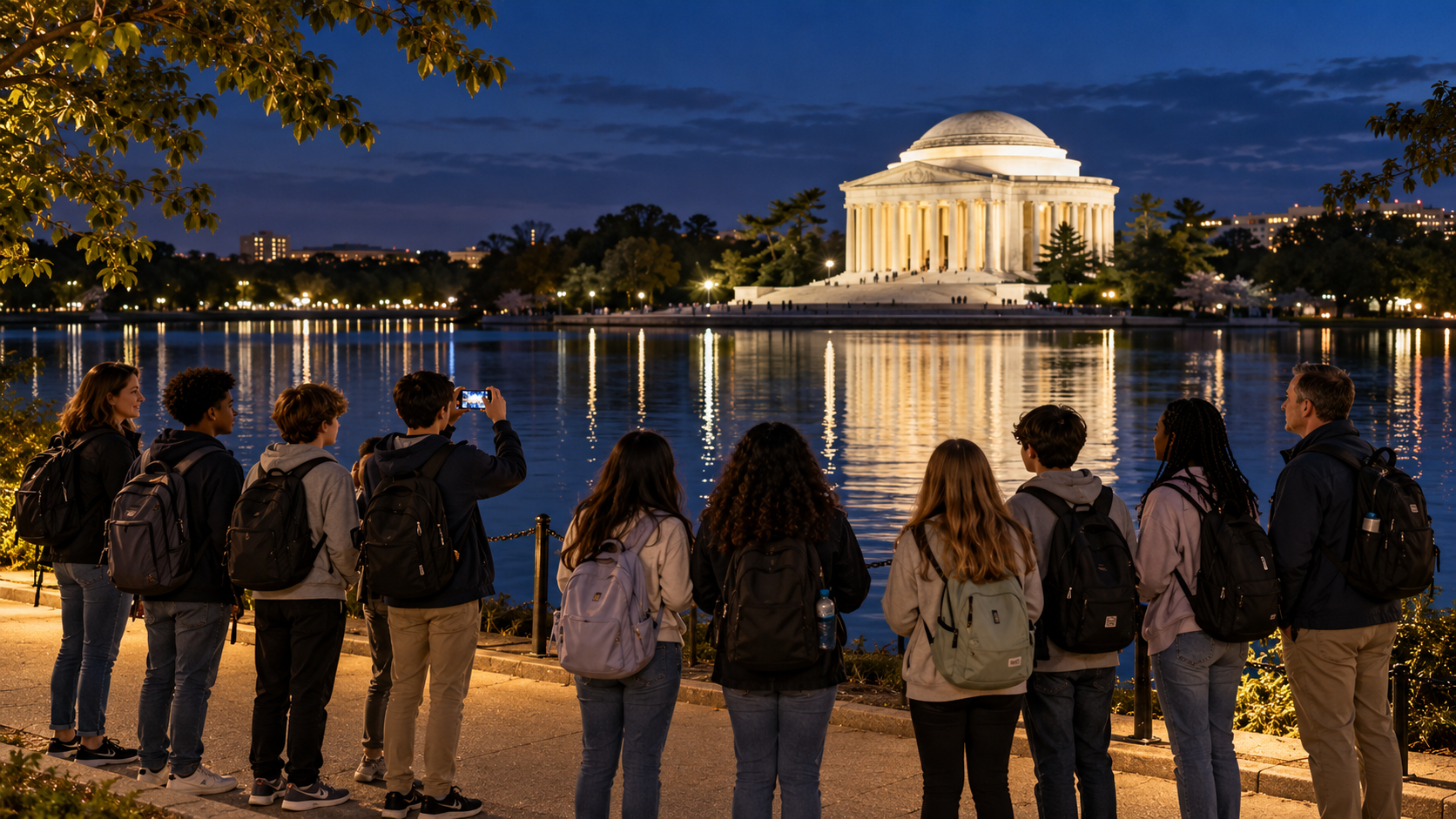
Touring Washington’s monuments after dark can be the most memorable part of a student trip because the sites are illuminated, temperatures are often cooler, and the atmosphere encourages reflection. The experience works best with a compact walking route, planned motorcoach staging, repeated headcounts, and clear behavior expectations.
The Lincoln Memorial at 9 p.m. is a different place than the Lincoln Memorial at 2 p.m. The crowds thin. The marble glows. Sixteen-foot Lincoln sits in his chair looking out over the Reflecting Pool, and a group of 13-year-olds goes quiet in a way they simply don't in daylight.
Every veteran trip planner knows this: the nighttime monuments tour is the emotional high point of middle school D.C. field trips. Here's why it works — and how to do it safely.
Why night works
The light. The memorials are floodlit after dark, and the effect is genuinely dramatic. The Lincoln Memorial, the Jefferson Memorial across the Tidal Basin, the white pylons of the World War II Memorial — they were designed to be seen this way.
Fewer crowds. Daytime on the Mall means tour buses, school groups, and tourists stacked three deep at every viewpoint. After dinner, the crowds thin considerably, which means your group can actually gather, hear the guide, and have a moment.
Cooler temperatures. Spring in D.C. can be warm by afternoon. A 7:30 or 8 p.m. start means students are comfortable walking — and comfortable students are attentive students.
The emotional impact. There's a reason the nighttime tour is the part students remember. The Vietnam Veterans Memorial — a black granite wall of 58,000+ names — in the dark, with the names lit and reflected, hits harder than any classroom lesson. Darkness focuses attention. The memorials become places of reflection rather than photo stops.
The classic loop
A well-planned nighttime tour covers five memorials in about two to two-and-a-half hours. This is the route that works:
1. Lincoln Memorial — the anchor. Climb the steps, read the Gettysburg Address and Second Inaugural carved into the walls. Give students five minutes of silence to read and look.
2. Vietnam Veterans Memorial — a short walk down the Mall. The wall at night is the most moving stop on the tour. Brief students beforehand on etiquette: quiet voices, no climbing, no touching the wall casually.
3. Korean War Veterans Memorial — the 19 stainless-steel soldiers on patrol, lit from below in the dark, are haunting. Students often find this the most visually striking memorial.
4. World War II Memorial — the fountain plaza with its 56 pillars, one per state and territory. At night the water and lights make it feel ceremonial.
5. Jefferson Memorial — across the Tidal Basin. The dome lit against the night sky is the postcard shot, and the rotunda's quiet is a good place to end the evening.
Optional add: the Martin Luther King Jr. Memorial, the "Stone of Hope" emerging from the "Mountain of Despair," is powerful at night and ties directly to the Civil Rights unit. If you visited the National Museum of African American History and Culture that day, the pairing is perfect.
Safety at night: where planning really matters
Here's the honest truth: a nighttime monuments tour with 40–80 middle schoolers is the part of the trip that separates professional operators from everyone else. Darkness, open ground, water (the Reflecting Pool, the Tidal Basin), and tired teenagers are a combination that demands real planning.
This is exactly where Son Tours' background shows. Our itineraries are vetted by former intelligence and military professionals — founders who served with the CIA and the 82nd Airborne — and every group travels with a private uniformed security professional at no extra cost. On a night tour, that means:
· Well-lit, pre-walked routes. We don't improvise. Routes are planned in daylight, checked for lighting and footing, and walked with the group leader before students arrive.
· Headcounts at every stop. Count on, count off — at every single memorial, before the bus rolls and after it stops.
· The buddy system, enforced. No student walks alone at night. Ever.
· Chaperone positioning. Adults at the front, middle, and rear of the group, with a designated sweep. Your dedicated trip coordinator — one person who knows your school, not a call center — manages the logistics so teachers can focus on students.
For parents reading the itinerary at home, that security presence is often the detail that turns a "maybe" into a "yes." It's included in every Son Tours trip, not upsold.
Logistics: timing, dinner, and the bus
Timing: Start 30–45 minutes after dinner ends — often 7:30 to 8:00 p.m. in spring. Plan 2 to 2.5 hours, which puts students back at the hotel by 10:00–10:30 p.m. Don't start too late; exhausted students at midnight memorials retain nothing.
Dinner first, near the Mall. Eat within easy reach of the memorials so you're not burning an hour in transit. Group-friendly restaurants near the Mall fill up fast in spring — another reason to book early. (See the best time of year for a student trip to D.C. for seasonal planning.)
Motorcoach staging. The bus can't park at every memorial. Your driver stages at designated points while the group walks between nearby stops (Lincoln → Vietnam → Korean War is walkable; the bus meets you for the WWII Memorial and Jefferson). A coordinator who knows the staging rules keeps the evening moving instead of waiting on a bus.
What students need: Comfortable walking shoes (non-negotiable — this is a 1.5+ mile evening), a light jacket even in spring, and a water bottle. Phones for photos are fine; set the expectation that the Vietnam Memorial is for reflection, not selfies.
The payoff
Daytime D.C. teaches. Nighttime D.C. moves. The combination — museums and the Capitol by day, the glowing memorials by night — is what turns a field trip into a core memory.
Frequently Asked Questions
-
It can be when the route, supervision, transportation, and regrouping points are planned in advance. Keep students in assigned groups and use experienced on-site staff for movement between stops.
-
The Lincoln, Vietnam Veterans, Korean War Veterans, and World War II memorials form a strong evening sequence. The Jefferson and Martin Luther King Jr. memorials can be added when timing and motorcoach access allow.
-
Plan about two to two and a half hours for a student-friendly route. That allows time for walking, headcounts, interpretation, and quiet reflection without pushing the group too late.
-
Comfortable walking shoes, water, and a light layer are the essentials. Teachers should also set phone and photography expectations before reaching solemn sites.
Plan the Next Step
Use this guide to clarify your priorities, then compare dates, inclusions, and responsibilities in writing. Explore Son Tours’ Washington, D.C., student trips or request a school-specific quote when you are ready to turn the research into an itinerary.
