
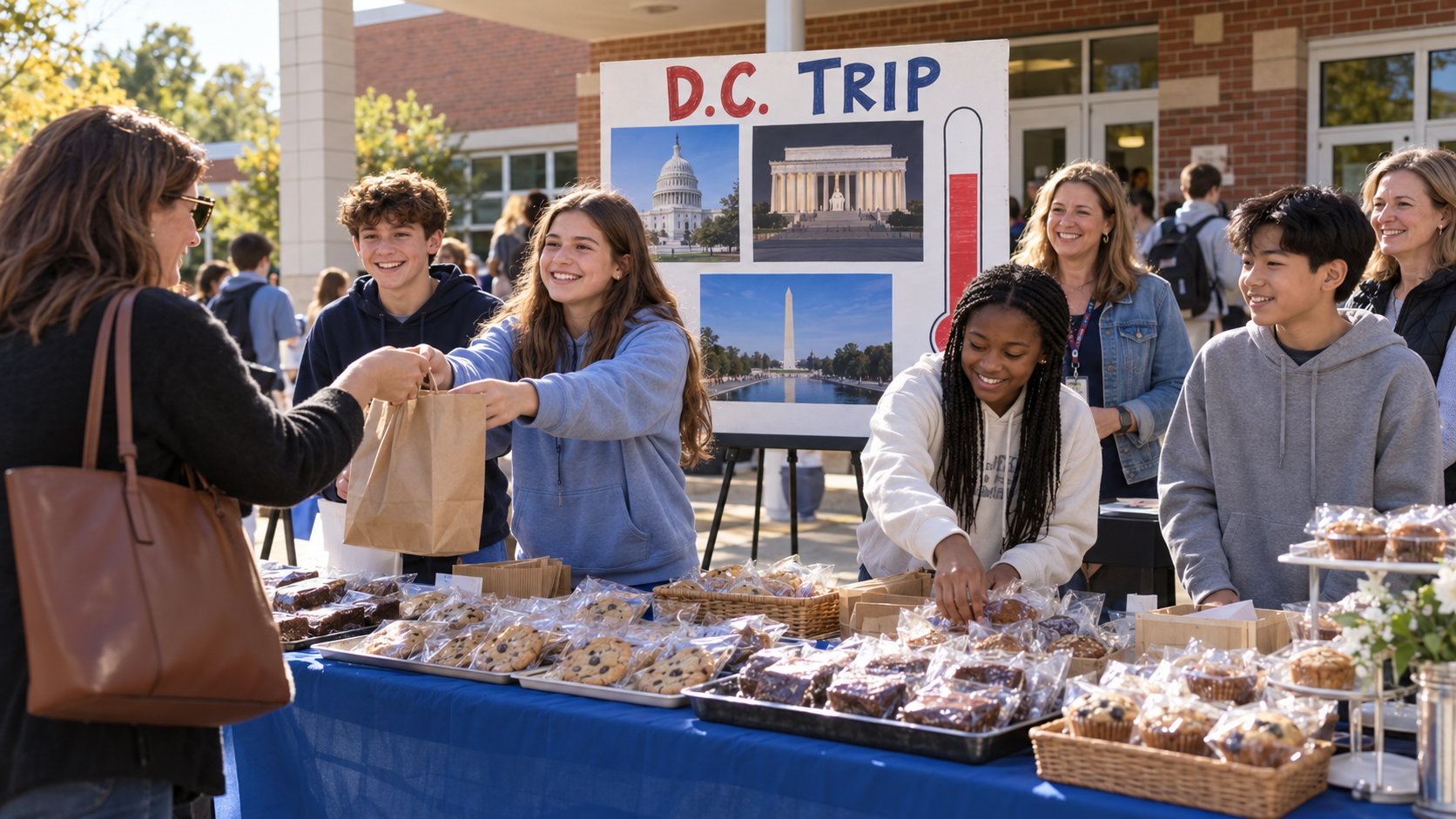
The most effective D.C. trip fundraising plan combines several methods: local sponsorships for larger gifts, student-led campaigns for participation, restaurant nights or community events for visibility, and payment plans that make the remaining balance manageable. Start nine to twelve months ahead and communicate one clear goal, timeline, and payment schedule.
A middle school trip to Washington D.C. is one of the most memorable experiences of a student's school career — and one of the hardest sells when the per-student cost lands in a family's inbox. The schools that get the most students on the bus aren't the wealthiest ones; they're the ones that fundraise with a plan, starting early and giving families multiple ways to bring the cost down.
Here are proven, school-tested fundraising ideas, plus the structural moves — payment plans, direct parent invoicing — that make the biggest difference of all.
1. Local Business Sponsorships With a Civics Tie-In
This is the highest-return fundraiser most schools run, and it fits a D.C. trip perfectly. Approach local businesses — banks, law firms, real estate offices, restaurants — with a sponsorship letter that connects their support to the mission: helping our 8th graders stand where American history happened.
Offer tiered recognition: logo on the trip t-shirt, a thank-you in the school newsletter, a framed group photo from the Capitol steps. Businesses respond to the civics angle because it's genuinely compelling — they're investing in citizenship, not just a field trip. A handful of $250–$500 sponsorships can take a meaningful chunk off every student's cost.
2. Restaurant Fundraising Nights
The old reliable, because it works. Partner with local restaurants that offer school fundraising nights — often donating 10–20% of an evening's sales from your supporters. Promote it hard: flyers home, social media, the school marquee. Stack two or three across the fall and they add up.
Pro tip: choose restaurants near the school on weeknights when families eat out anyway. You're redirecting existing spending, not asking for new spending — that's why participation stays high.
3. Student-Led Campaigns
Car washes, yard-work days, bake sales, holiday gift wrapping — the classics endure because they teach what the trip is about: effort earns opportunity. A few that punch above their weight:
· Discount card sales. Students sell cards offering deals at local businesses. Low cost to produce, easy to sell, and local merchants love the foot traffic.
· Yard signs and spirit gear. Custom "Future D.C. Traveler" yard signs or class-designed t-shirts sell to proud grandparents especially well.
· Service-a-thons. Students collect pledges for community service hours — park cleanups, food bank shifts. It fundraises and builds the service ethic the trip celebrates.
Keep student-led efforts tied to individual accounts where possible, so the students who hustle see the direct benefit in their own trip balance.
4. Crowdfunding Done Right
A well-run online campaign can reach the grandparents, aunts, uncles, and family friends who'd happily contribute $25 but would never attend a car wash. Set it up with:
· A clear goal and deadline tied to your payment schedule
· A short video of students explaining what the trip means (teachers: this is the part that opens wallets)
· Regular updates — "We're 60% funded!" posts drive second-wave donations
· Individual student pages under a team umbrella, so sharing is personal
One caution: check your district's policy on crowdfunding platforms before you launch. Some districts have approved-vendor lists.
5. PTO Grants and Community Foundations
Don't overlook institutional money. Many PTOs maintain scholarship funds for exactly this purpose — students who'd be left behind by cost. Apply early; these funds are finite and first-come. Local community foundations, rotary clubs, and veterans' organizations also fund youth civic education. Given that Son Tours is a veteran-owned company founded by former intelligence and Army professionals, veterans' groups often feel a natural affinity for supporting these trips — worth mentioning in your application.
6. Payment Plans: The Fundraiser That Isn't One
Here's the structural move that matters as much as any fundraiser: spread the cost over time. A $750 trip is daunting as a lump sum; it's $125 a month over six months, which changes the conversation entirely for many families.
This is also where your tour operator choice matters operationally. Son Tours invoices parents directly and manages payment plans as part of the service — so teachers aren't chasing checks, tracking spreadsheets, or playing debt collector in the faculty lounge. When you're comparing Washington D.C. student tours, ask how parent payments work. The answer tells you a lot about how much administrative burden is about to land on your desk.
Start Early, Communicate Clearly
Every one of these ideas works better with lead time — which is why fundraising is another argument for booking early (see how far in advance to book a D.C. student trip). A practical timeline:
· 12 months out: Announce the trip with the target cost (see our breakdown of how much an 8th grade D.C. trip costs), launch sponsorship outreach, open payment plans.
· 9 months out: First restaurant night, student-led campaigns begin.
· 6 months out: Crowdfunding push, PTO scholarship applications.
· 3 months out: Final balances, last-chance fundraisers for stragglers.
And communicate the plan in one clear document: total cost, payment schedule, fundraising opportunities, and who to contact with questions. Families support what they understand.
The Bottom Line
No single fundraiser pays for a D.C. trip. The schools that succeed layer several of these — sponsorships for the big dollars, student campaigns for engagement, payment plans for manageability — and start early enough for all of them to work. The goal isn't just lowering the price; it's making sure cost doesn't decide which students get to stand in the Capitol Rotunda.
Son Tours has helped schools fund and plan 8th grade D.C. trips for 30+ years — with direct parent invoicing, flexible payment plans, and a dedicated coordinator who can advise on what fundraising timelines work best for your travel dates.
Frequently Asked Questions
-
Local business sponsorships often produce the highest return for the time invested, especially when the request connects the trip to civics education. Most schools do best by pairing sponsorships with smaller student-led fundraisers.
-
Begin as soon as the trip price and payment dates are known, ideally nine to twelve months before travel. More time allows families to spread out both fundraising and personal payments.
-
Yes, if school policy allows it. Use a school-approved platform, explain the educational purpose clearly, protect student privacy, and state how excess or unused funds will be handled.
-
Combine fundraising with installment plans, early booking, shoulder-season dates, direct parent invoicing, and a defined scholarship process. Affordability improves when families see the full plan early.
Plan the Next Step
Use this guide to clarify your priorities, then compare dates, inclusions, and responsibilities in writing. Explore Son Tours’ Washington, D.C., student trips or request a school-specific quote when you are ready to turn the research into an itinerary.
