
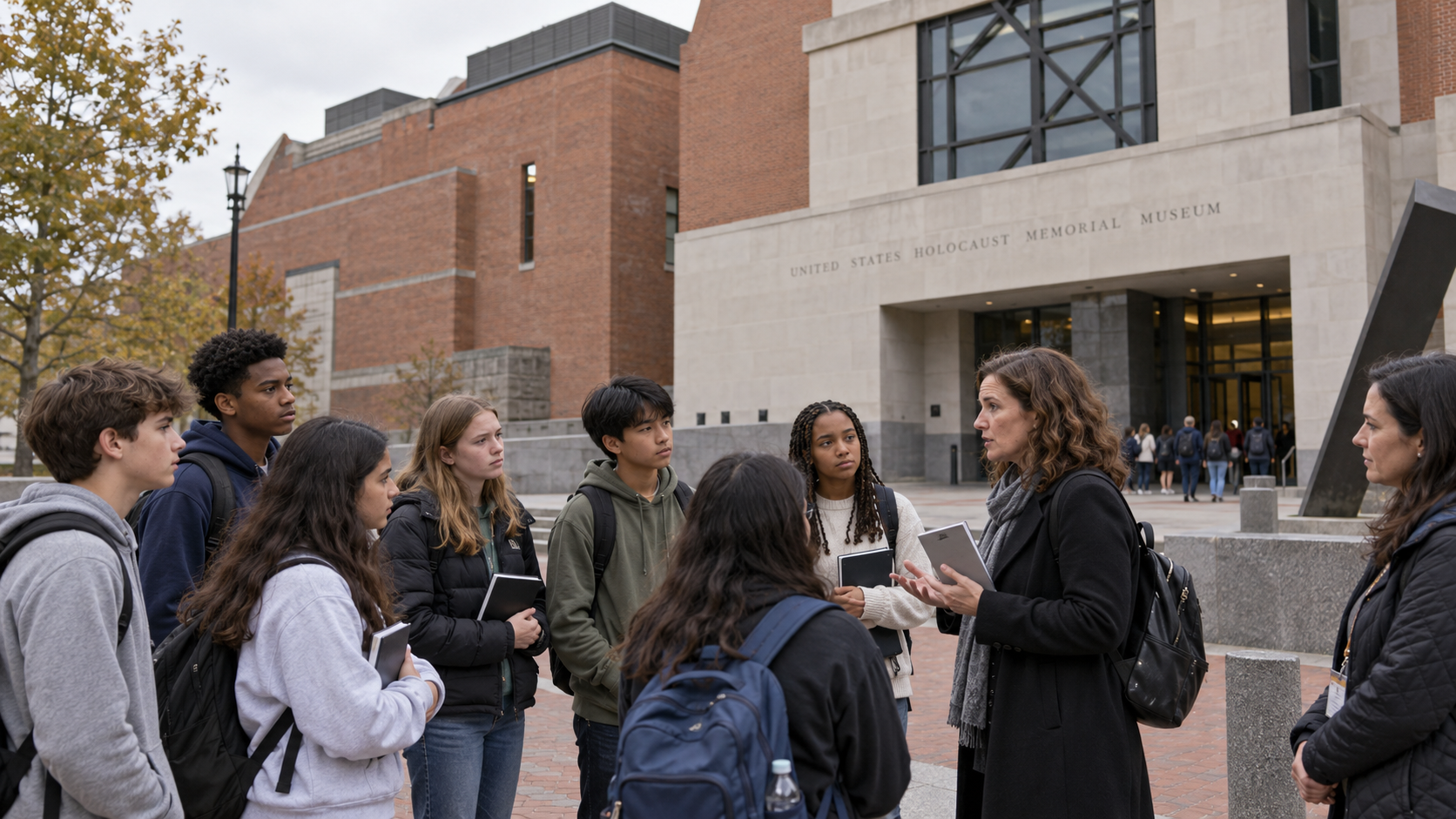
The U.S. Holocaust Memorial Museum’s main exhibition is generally appropriate for prepared eighth graders, but the visit should never be treated as an ordinary museum stop. Teachers should preview the content, prepare students for difficult material, offer an alternative when needed, and make time for a guided debrief afterward.
"Is the Holocaust Museum appropriate for 8th graders?" It's one of the most common questions we hear from teachers planning middle school trips to Washington D.C. — and it deserves an honest answer, not a reassuring one.
Here it is: yes, 8th grade is generally an appropriate age for the U.S. Holocaust Memorial Museum's Permanent Exhibition — with preparation. The museum itself recommends the exhibition for visitors 11 and older. Your 13- and 14-year-olds are in that range. But "appropriate" doesn't mean "easy," and it doesn't mean you walk in cold.
What's actually intense — so you can prepare
Teachers should know what's coming so they can prepare students, not shield them from it. The Permanent Exhibition is a chronological walk through the history of the Holocaust, and some sections are deliberately difficult:
· The railcar. Visitors walk through an actual railcar used to transport victims to the camps. It's dark, it's cramped, and the scale of it lands physically.
· The shoes. A room filled with thousands of shoes taken from victims. Students who have skimmed past statistics in a textbook stop cold here. It's the single most affecting room in the museum for young visitors.
· The films. Archival footage plays throughout, including graphic liberation footage. There are warning signs before the most difficult films, and students can step past them — make sure yours know that's allowed and that choosing to step past is not weakness.
· The Tower of Faces. A three-story tower of photographs from a single shtetl, showing the vibrant community that was destroyed. Less graphic than other sections, but emotionally devastating in its own way.
None of this is gratuitous. But a student who walks in expecting "a museum about World War II" will be unprepared. A student who walks in having discussed, in class, what they are about to see — and why it matters — will be ready.
Daniel's Story: the alternative for younger or sensitive students
If your group includes 6th or 7th graders, or you have students you're concerned about, the museum offers Daniel's Story — an exhibition designed for children 8 and up that tells the Holocaust through the eyes of a young boy. It's honest without being graphic, and it gives younger students a meaningful experience at the museum without the intensity of the Permanent Exhibition.
Even for 8th graders, knowing Daniel's Story exists is useful: if a student becomes overwhelmed in the Permanent Exhibition, chaperones can redirect them there rather than sending them to sit in the lobby.
Pre-visit classroom preparation
This is the single most important part of the visit, and it happens weeks before you board the bus. Students who have context carry the experience; students who don't just endure it.
· Teach the history first. The museum is not an introduction — it's a deepening. Students should arrive knowing what the Holocaust was, who the Nazis were, and the basic timeline. If the museum is their first encounter with the subject, it's too much too fast.
· Assign the Identity Card. The museum gives each visitor an identity card of a real Holocaust victim or survivor to carry through the exhibition. In class beforehand, have students research "their" person if possible, or at least discuss what it means to carry someone's story.
· Set expectations explicitly. Tell students: parts of this will be disturbing. That's intentional. You may feel upset, angry, or numb — all of those are normal. You can step past any film. You can ask a chaperone to walk with you. No one will think less of you.
· Connect it to the curriculum. The Holocaust sits at the intersection of history, civics, and ethics — propaganda, bystander behavior, the fragility of democratic institutions. Our guide to how a D.C. trip maps to 8th-grade civics standards can help you frame the learning objectives.
For structured classroom ideas, see our pre-trip classroom activities for a D.C. field trip.
Timed-entry passes: book early
The Holocaust Memorial Museum requires free timed-entry passes for the Permanent Exhibition, and they are among the hardest tickets in D.C. to get in spring — they routinely sell out weeks or even months ahead. This is not a museum you can add to the itinerary at the last minute.
When you plan 8th grade D.C. trips with Son Tours, we secure timed passes as part of the itinerary planning — early, before they're gone. It's one of the quiet logistics that makes or breaks a spring trip.
After the visit: the debrief matters as much as the visit
Don't schedule the Holocaust Museum immediately before lunch or a lighthearted stop. Build in decompression time — a quiet walk, journaling on the bus, or a guided discussion that evening.
Some prompts that work with 8th graders:
· What one object or image will you remember, and why?
· The museum emphasizes the choices of bystanders, not just perpetrators. What does that mean for us?
· Daniel's Story and the identity cards put individual faces on history. Why does that matter more than statistics?
The goal isn't to test comprehension. It's to give students a place to put what they felt.
A final note for teachers
Some teachers worry the museum will be "too much" and consider skipping it. We understand the instinct — but in our experience, 8th graders are ready for this, and many will tell you afterward it was the most important thing they saw in D.C. The Holocaust is part of their history curriculum for a reason. A well-prepared visit, handled with care, is one of the most powerful educational experiences a school trip can offer.
Frequently Asked Questions
-
The museum identifies its Permanent Exhibition for visitors age 11 and older, making it suitable for many eighth graders with preparation. Teachers should still consider individual maturity, prior learning, and emotional needs.
-
Provide historical context, explain that students will encounter disturbing evidence, review respectful behavior, and give them a reflection question before entering. Avoid surprise as a teaching strategy.
-
Allow about 90 minutes to two hours for a thoughtful visit, depending on the exhibition and group needs. Build in time afterward for decompression and discussion.
-
Ask the museum about current age-appropriate exhibitions and educational resources when planning. Teachers can also create a supervised alternative that covers the history without placing a student in an experience they are not ready to process.
Plan the Next Step
Use this guide to clarify your priorities, then compare dates, inclusions, and responsibilities in writing. Explore Son Tours’ Washington, D.C., student trips or request a school-specific quote when you are ready to turn the research into an itinerary.
