
A Washington, D.C., trip supports eighth-grade civics by connecting the three branches, founding documents, citizenship, civil rights, and historical evidence to real institutions and objects. Teachers can strengthen approval and assessment by mapping each stop to a standard before travel and collecting student work afterward.
You know the trip is worth it. Your principal may need convincing. So here it is: the stop-by-standard breakdown that turns your Washington D.C. field trip from a "nice experience" into a curriculum-aligned instructional investment. Bring this page to your principal — it's built for exactly that conversation.
Why 8th grade is the year
Eighth grade is when the civics and U.S. history sequence converges: founding documents, the three branches, the Constitution's evolution, and the responsibilities of citizenship. Most state standards place the heaviest civics load in middle school precisely because students are old enough to reason about government and young enough to be formed by the experience. A trip to the nation's capital doesn't replace that instruction — it makes it permanent. Students remember where they were standing when they understood the three branches. Nobody remembers the worksheet.
Stop-by-standard mapping
The U.S. Capitol → The Legislative Branch
Standards connection: structure and function of Congress; how a bill becomes a law; representation and the House/Senate distinction.
Standing in the Rotunda, under Brumidi's fresco, the legislative branch stops being an abstraction. A guided Capitol visit connects directly to standards on congressional powers, the lawmaking process, and federalism. When students see the scale of the building and learn what happens in those chambers, "representative democracy" finally has a physical address. For 8th grade D.C. trips, this is the anchor stop — and with 2026 being America's 250th, the Capitol's programming around the founding era makes this year especially rich.
The White House (exterior and visitor center) → The Executive Branch
Standards connection: powers and limits of the presidency; checks and balances; the electoral process.
Students can't tour the White House on a standard school trip, but standing at the fence line and visiting the White House Visitor Center anchors the executive branch standards beautifully. The presidency becomes a real office with real constraints — and that sets up classroom discussion of checks and balances far better than a textbook diagram. Pair this stop with the Capitol visit and students walk away with two branches they can picture.
The Supreme Court → The Judicial Branch
Standards connection: judicial review; the role of the courts; landmark cases; due process.
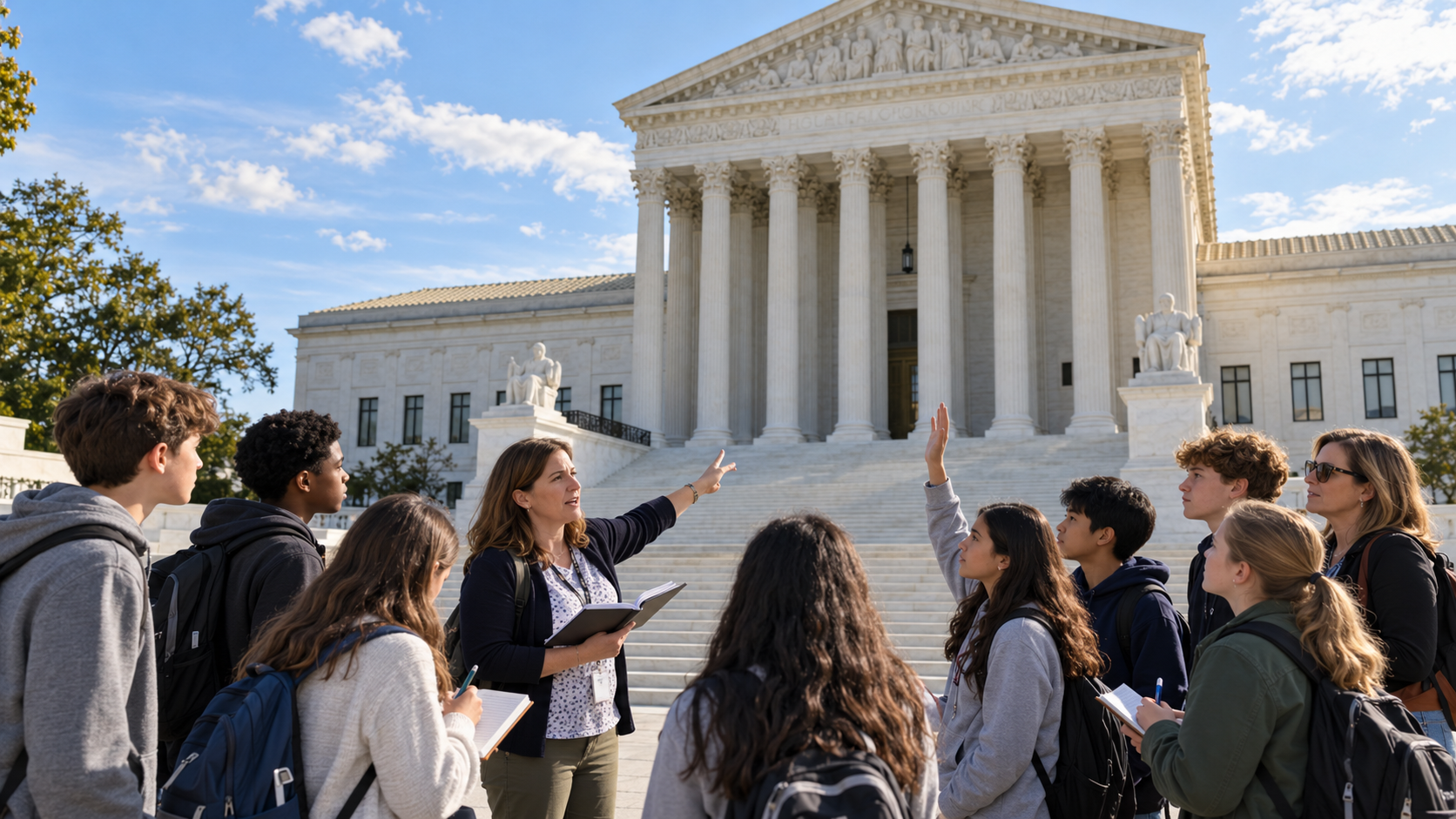
The Supreme Court building makes the least-visible branch visible. Even from the public areas, students grasp that this is where constitutional questions get settled — Marbury v. Madison stops being a vocabulary term and becomes a place. For classes that teach landmark cases, this stop is the payoff: students stand where the decisions happened and the cases click into a larger story about the rule of law.
The National Archives → Founding Documents
Standards connection: the Declaration of Independence, the Constitution, and the Bill of Rights; primary source analysis; the principles of American democracy.
This is the single most curriculum-dense stop in the city. The Charters of Freedom — the actual Declaration, Constitution, and Bill of Rights — are the primary sources behind half your year's standards. Build the visit around a close-read activity (see our pre-trip classroom activities for a D.C. field trip) and the Archives becomes a lesson, not a photo stop. In the 250th anniversary year, the founding documents carry extra weight — your students are seeing them during the semiquincentennial of the nation they created.
The Memorials → Civic Virtue, Sacrifice, and Citizenship
Standards connection: civic participation; the cost of preserving democracy; civil rights; national memory.
The Lincoln Memorial connects to the Civil War, emancipation, and the ongoing work of "a more perfect union." The WWII, Vietnam, and Korean War memorials make sacrifice concrete and open the door to discussions of veterans' service and civic duty. The Martin Luther King, Jr. Memorial anchors civil rights standards. The memorials are where the emotional learning happens — and emotional learning is what students retain years later.
Consider arranging a wreath-laying ceremony at Arlington National Cemetery, which we walk through in our guide to how to arrange a wreath-laying ceremony at Arlington. There is no better lesson in civic virtue than students laying a wreath at the Tomb of the Unknown Soldier.
The Smithsonian Museums → Inquiry and Evidence
Standards connection: historical thinking skills; analyzing artifacts and evidence; research and inquiry.
The National Museum of American History and the National Museum of African American History and Culture are built for the inquiry standards: students practice reading artifacts, questioning narratives, and weighing evidence. A focused museum visit with a guiding question — not a wander — turns the world's best free museums into a research lab.
How to use this page with your administration
Administrators approve trips that demonstrate instructional value, not just enthusiasm. Use this article as documentation:
1. Attach it to your trip proposal alongside your itinerary, so the curriculum connection is visible up front.
2. Map it to your state's specific standards — the stops above align with the standard 8th-grade civics strands (founding documents, three branches, citizenship) taught in virtually every state.
3. Reference the post-trip work. Administrators also want to know the learning is measured. Our guide to post-trip assignments that prove educational value gives you the assessment piece — reflections, projects, and presentations that demonstrate ROI to school boards.
Built around YOUR curriculum, not a template
Here's what makes Son Tours different on the curriculum side: we don't run a fixed route and call it educational. Our itineraries are fully customizable and curriculum-aligned — built around what you're actually teaching. If your class is deep in the Constitution unit, we weight the Archives and the Supreme Court. If you're focused on civil rights, we build in the MLK Memorial and the African American History Museum. Every itinerary is planned by a veteran-led team (founders: former CIA and Army, 82nd Airborne) with 30+ years of experience, and your school gets one dedicated coordinator — no call centers — who learns your curriculum goals and builds the trip around them.
Safety is the other half of the curriculum conversation, because learning doesn't happen when students don't feel secure. Son Tours includes private uniformed security at no extra cost and vets every hotel and route in advance — the details are in our honest answer to whether D.C. is safe for student groups.
The bottom line
A D.C. trip isn't a break from the curriculum. It's the curriculum, standing up. Capitol to Congress. Archives to the founding documents. Memorials to civic virtue. Map the stops to your standards, bring this page to your principal, and build the trip around what you're teaching.
Frequently Asked Questions
-
The Capitol, White House, Supreme Court, National Archives, memorials, and Smithsonian museums provide direct connections to government structure, founding principles, citizenship, and evidence-based inquiry.
-
It becomes instruction when sites are tied to learning goals, students arrive with background knowledge, guides reinforce the curriculum, and teachers use reflection or assessment after the trip.
-
Present a stop-by-standard map, sample itinerary, safety plan, cost outline, and post-trip assessment plan. This shows that the trip has defined outcomes rather than a general educational purpose.
-
Photo essays, document reflections, civic-action proposals, podcasts, journals, and student presentations can all demonstrate learning. Choose assignments that require students to use evidence from sites they visited.
Plan the Next Step
Use this guide to clarify your priorities, then compare dates, inclusions, and responsibilities in writing. Explore Son Tours’ Washington, D.C., student trips or request a school-specific quote when you are ready to turn the research into an itinerary.
