
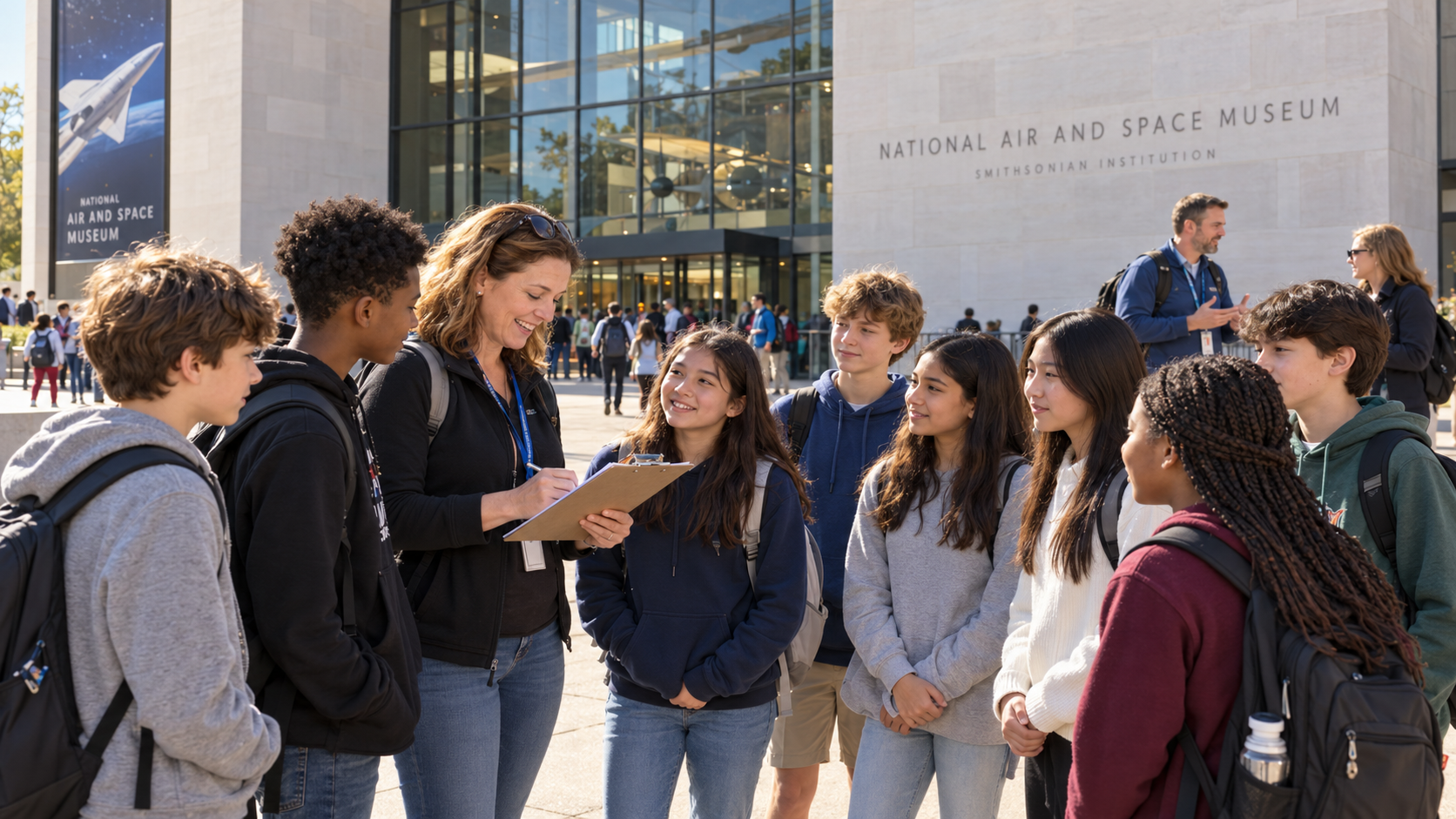
Ask any teacher who's led middle school trips to Washington D.C. what made the trip work, and they'll talk about the chaperones. In a busy city, with 13-year-olds, across museums, memorials, and a hotel — the adults are the infrastructure. Get the ratio and the roles right, and the trip runs itself. Get them wrong, and you'll feel it by lunchtime on day one.
Here's what experienced group leaders recommend, the roles that actually matter, and how the right tour operator takes pressure off your parent volunteers instead of adding to it.
The Recommended Ratio: 1:8 to 1:10
For middle school groups in a major city, the widely recommended chaperone-to-student ratio is one adult for every 8 to 10 students. A group of 40 students, for example, travels best with 4–5 chaperones plus the lead teacher.
Why this range? At 1:10, each chaperone manages a small, accountable subgroup — small enough to do headcounts in seconds, large enough that you're not recruiting half the PTA. Go much beyond 1:12 and subgroups get unwieldy in crowded museums and Metro stations. Go much below 1:8 and you're asking more parents to take time off work than necessary.
A few things that shift the number:
· First-time travelers or younger groups (6th–7th grade) do better at the 1:8 end.
· Students with medical or behavioral needs may require dedicated coverage — plan for it explicitly rather than hoping the ratio absorbs it.
· Your school or district policy may set its own minimum. Check it before you promise parents anything.
And note: the ratio counts adults who are actively supervising, not parents who are along for the ride. Every adult on the trip should have an assignment.
Chaperone Roles That Actually Matter
"Chaperone" is too vague to be useful. The trips that run smoothly assign specific jobs. Here are the roles that matter most:
Bus captains. Each motorcoach needs a lead adult responsible for that bus: attendance before every departure, the first-aid kit, the "did anyone leave a phone at the museum" check. Nothing leaves until the bus captain confirms the count.
Subgroup leaders. Divide students into buddy-system groups of 8–10, each anchored by a chaperone. The chaperone knows every name, every allergy, every medication in their subgroup. In a crowded Smithsonian atrium, this is the unit that matters.
Headcount callers. Sounds simple; saves trips. Designate who's calling the count at every transition — off the bus, out of the museum, into the restaurant. Two callers per subgroup (chaperone + a responsible student) is even better.
Hotel floor monitors. Evenings are the highest-risk window on any student trip. Assign chaperones to floors — not just rooms — with a clear lights-out protocol, a room-check schedule, and a rule that no student leaves their floor after check-in without an adult.
The medic. One adult holds the master list of medications, allergies, and emergency contacts, plus the first-aid supplies. Make sure every chaperone knows who this person is.
The photographer / communicator. One chaperone manages the parent-facing updates — photos in a shared album, a nightly "everyone's safe and accounted for" message. It keeps parents calm and keeps every other adult focused on supervision instead of their phones.
Recruiting and Preparing Chaperones
Start recruiting early — the same parents who volunteer for everything are your best first calls, but don't rely on memory. Send a clear invitation that states the expectations: this is a working trip, not a vacation. Chaperones stay with their subgroup, enforce the rules, and follow the itinerary.
Hold a pre-trip meeting (in person or virtual) covering:
· The full itinerary and timing
· Subgroup assignments and buddy-system rules
· The behavior contract students signed — chaperones enforce it
· Emergency procedures and who to call first
· Hotel protocols: room checks, lights-out, floor assignments
· What to do if a student is separated from the group
A written one-page chaperone guide — roles, phone numbers, schedule — beats a long speech. Laminate it. Chaperones will thank you.
Free and Discounted Chaperone Spots
Here's the budget question every planner asks: do chaperones pay? Most student tour operators offer complimentary or discounted chaperone spots at a set ratio — commonly one free chaperone per 10 paying students, with additional adults at a reduced rate. Policies vary significantly between operators, so get the comp ratio in writing before you compare quotes.
Son Tours includes chaperone comp policies in every detailed proposal, so you know exactly how many adults travel free and what additional chaperones cost. When you're evaluating Washington D.C. student tours, this is one of the line items that separates a genuinely complete quote from a teaser price — right alongside the question of whether security is included or extra.
How Son Tours Lightens the Load on Your Chaperones
Here's what separates a well-supported trip from an exhausting one: your chaperones shouldn't have to be the tour guides, the navigators, the security team, and the logistics coordinators on top of supervising kids.
On a Son Tours trip, your adults get backup:
· A dedicated coordinator plans the trip with you from quote to return — one person who knows your group, not a call center.
· On-site tour staff handle navigation, timing, tickets, and transitions, so chaperones can focus on students instead of logistics.
· Private uniformed security is included at no extra cost — including evening hotel security, the shift parents worry about most.
· Every itinerary is vetted for safety by former intelligence and military professionals before your group arrives.
The result: your chaperones do the job they signed up for — caring for kids — instead of the five jobs they didn't. That's also why so many schools come back: after 30+ years running 8th grade D.C. trips, Son Tours maintains a 95% client retention rate, and supported chaperones are a big part of why.
If you're still shaping the trip itself, our sample 3-day middle school D.C. itinerary shows how the days are structured around these supervision realities — and our guide to how far in advance to book will help you give chaperones the lead time they need.
Request a custom quote for your school's D.C. trip → We'll build the chaperone plan into your proposal — ratios, comp spots, and the on-site support that lets your adults actually enjoy the trip.
